Confined Space Entry Training: What Classroom Sessions Cannot Teach

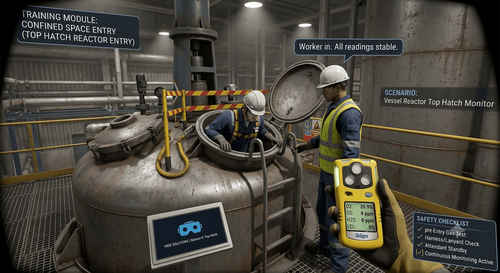
The hazard workers cannot see, the rescue that kills more people than the original incident, and why this procedure resists classroom training.
Confined space entry has a statistic attached to it that most safety professionals know and most workers do not.
A significant proportion of people who die in confined spaces are not the original entrant. They are the would-be rescuer — a colleague who saw someone collapse, went in to help, and was overcome by the same atmosphere within seconds.
That single fact tells you almost everything about why confined space training is difficult. The fatal decision is not made by an untrained worker being careless. It is made by a trained worker acting on instinct, in the few seconds after they see a colleague fall.
You cannot fix that with a policy document. Instinct is not overwritten by information.
Why this procedure resists classroom training specifically
Most industrial hazards are perceptible. A moving conveyor looks dangerous. A hot surface radiates. A height feels like a height.
Confined space atmospheres are the opposite. An oxygen-deficient tank looks exactly like a safe tank. A vessel containing hydrogen sulphide at concentrations that cause immediate collapse may register as a bad smell for a moment and then register as nothing at all, because the gas deadens the sense of smell at precisely the concentrations that are most dangerous. Nitrogen-purged equipment looks, sounds and feels completely normal.
The entire hazard is invisible, and human risk perception is built on sensory input.
This creates a specific training problem. Workers can be told, accurately and repeatedly, that a space they have entered fifty times without incident may kill them on the fifty-first. They will nod. They will pass the test. And then, on a busy shift, they will lower themselves into a tank that looks exactly like the tank they entered yesterday, because nothing in their sensory experience is generating the alarm that the training was trying to install.
Classroom instruction delivers the information. It does not create the felt sense of danger that produces hesitation at the hatch.
What the failure sequence actually looks like
Look at how confined space incidents unfold and the same steps recur.
Atmospheric testing skipped, abbreviated or misread. The space was tested this morning, or last shift, or before the previous job. Conditions changed — residue reacted, a purge was reintroduced, hot work consumed oxygen, sludge was disturbed and released gas. Or the test was done at the hatch rather than at multiple depths, missing a heavier-than-air gas pooled at the bottom.
Permit treated as paperwork rather than process. The permit gets signed because the job is authorised, not because each control has actually been verified. Isolation is assumed. Ventilation is assumed. The permit becomes a record of intention rather than of verification.
Ventilation inadequate or interrupted. Equipment placed wrongly, capacity insufficient for the volume, or ventilation stopped part-way through the job because it was noisy or in the way.
Attendant leaves position. The person outside is pulled away for another task, goes to fetch a tool, or drifts out of sight and voice contact. The single most important control in the entire system is the one most often eroded by ordinary operational pressure.
Unauthorised rescue attempt. The entrant collapses. The attendant, or a passer-by, enters immediately to help. This is the step that turns one casualty into two or three, and it happens because the human response to seeing a colleague fall is overwhelmingly powerful and does not consult the procedure first.
Every one of these is a decision made in context. None of them are corrected by better documentation.
What confined space simulation actually trains
In VR, the trainee is at the hatch of a specific vessel in their own facility, with the actual configuration, access geometry and surrounding equipment.
They must complete the permit as a functional process rather than a form. Confirm isolation. Verify ventilation is running and adequate. Conduct atmospheric testing — and, critically, test at multiple depths, because the simulation models stratified gas exactly as it behaves in reality. A trainee who tests only at the opening gets a clean reading and a fatal outcome, and learns in one repetition what a hundred slides could not teach.
Conditions then change during the job, as they do in reality. Ventilation fails. Sludge is disturbed and releases gas. A hot work permit elsewhere alters the atmosphere. The trainee has to notice, interpret the monitor, and decide — continue, or evacuate. The correct decision costs production time and is inconvenient, which is exactly the pressure under which real workers get it wrong.
And the rescue scenario runs. The trainee is the attendant. The entrant collapses. Every instinct says go in. The simulation lets them go in, and shows them what happens when they do.
That specific experience — the felt pull to enter, the decision, the consequence — is the single highest-value thing confined space simulation delivers. It is the moment that reshapes the instinct, and it is not reproducible by any other training method that does not involve actual risk.
The atmospheric hazard becomes visible, and that matters
One capability worth calling out, because it is unique to simulation.
In VR, you can render the invisible. Oxygen concentration can be shown as a gradient. Gas accumulation can be displayed as a visible layer pooling at the base of a vessel. The atmosphere the worker cannot see can be made temporarily perceptible during training, and then switched off so they practise under realistic conditions.
This builds an accurate mental model of something workers otherwise have to take entirely on faith. A trainee who has seen how heavier-than-air gas settles into a low point, and how ventilation actually clears it, understands why the testing procedure specifies multiple depths. They are no longer following a rule. They are reasoning about a physical process they have observed.
That distinction — rule-following versus understanding — is what determines whether a procedure survives contact with an unfamiliar situation.
Permit-to-work, trained as a system
Confined space entry rarely fails as an individual error. It fails as a system error, involving the entrant, the attendant, the entry supervisor, and often an isolation authority and a rescue team.
Multi-user simulation trains this directly. Each participant takes their actual role, in the same virtual space, and the exercise tests coordination — whether the supervisor verified before authorising, whether the attendant maintained contact and communication, whether the roles understood their respective authority to stop the job.
Running this as a live drill requires taking a real vessel out of service, assembling every role, and standing down production. Most organisations manage it once a year, if that. In simulation it can run monthly, with varied failure conditions, at negligible marginal cost.
That frequency difference is the whole argument. Emergency response capability decays fast. Annual practice is not maintenance.
What you can evidence afterwards
For a regulated activity like confined space entry, the assessment record matters as much as the training.
Simulation generates evidence that a classroom register cannot. Whether the worker tested at appropriate depths on that specific vessel type. Whether they detected an atmospheric change during the job and how long it took them. Whether they evacuated when conditions demanded it or continued. Whether, as attendant, they entered during the rescue scenario — and whether that response changed across repeat attempts.
This turns your confined space competency record from a list of names into a behavioural profile you can act on. If forty percent of your attendants entered during the rescue scenario on first attempt, you have learned something urgent about your organisation that no audit would have revealed.
It also puts you in a materially stronger position with a regulator or an investigator, who will ask not whether training was delivered but whether competency was assessed.
Scoping notes
Cover the vessel types that actually exist on your site, with their real access geometry. Entry through a top hatch into a vertical vessel is a different procedure from side-entry into a horizontal tank, and generic geometry does not build transferable recognition.
Build the atmospheric variation, not just the base entry. The stratified gas case, the ventilation failure case, the mid-job change case. Static conditions teach a sequence; changing conditions teach judgement.
Include the rescue decision scenario. It is the highest-value component and is sometimes trimmed from scope as an extra. It should be treated as core.
Train contractors on the same modules as employees. Confined space work is heavily contracted in Indian industry, and contractor crews frequently carry the highest exposure with the least consistent training history.
The bottom line
Confined space entry is a procedure where the hazard is invisible, the fatal error is instinctive, and the correct action is counter-intuitive in the exact moment it is needed most.
Those three properties make it close to a worst case for classroom instruction, and close to a best case for simulation.
The organisations that have deployed confined space VR are not doing it because the technology is interesting. They are doing it because they need workers to hesitate at a hatch that looks perfectly safe, and to not run in after a fallen colleague — and there is no other way to practise either of those things without putting someone in a tank.
EDIIIE has been building enterprise-grade VR, AR, and Digital Twin simulation solutions for industrial training for over a decade. With 170+ projects delivered and 800+ VR experiences built for organisations including ISRO, DRDO, Hindalco, Tata Projects, and DMRC, we build permit-to-work and confined space simulations validated against your own vessels and procedures. Talk to us about your training challenge.