Lockout-Tagout Training in VR: Why Procedural Muscle Memory Beats a Checklist

"Why the most documented procedure in industrial safety keeps failing, and what changes when workers practise it instead of reading it.
Lockout-tagout is the most thoroughly documented procedure on most Indian shop floors. There is a written policy. There is a laminated sequence card near the panel. There is an annual training session. There is a signed register confirming attendance.
And energy isolation failures remain among the most persistent causes of serious industrial injury worldwide.
The gap between how well documented LOTO is and how often it goes wrong tells you something important. This is not a knowledge problem. Almost every worker involved in an isolation incident could recite the steps if you asked them in a classroom. They knew the procedure. They did not execute it — under time pressure, on an unfamiliar machine, during a shift handover, with a supervisor waiting and production stopped.
Knowing a sequence and performing it correctly under operational pressure are different capabilities. Most LOTO training only builds the first.
Where isolation procedures actually break down
Look at how energy isolation failures happen, and a pattern emerges. The failures cluster in a handful of predictable places, and none of them are addressed well by classroom instruction.
Incomplete energy identification. The worker isolates the obvious electrical supply and misses stored energy — a pressurised hydraulic accumulator, a suspended load held by gravity, residual pneumatic pressure, a capacitor bank, thermal energy in a jacketed vessel. The primary source is handled correctly. The secondary source causes the injury. This is a recognition failure, and recognition is built by repeated exposure, not by a bullet list.
Verification skipped under time pressure. The try-step — attempting to start the equipment to confirm isolation — is the step most frequently omitted, and its omission is almost always situational rather than intentional. Production is waiting. The worker is confident. Nothing has ever gone wrong before.
Group and shift-handover confusion. Multiple trades working on the same equipment, individual locks not applied, a group lockbox managed loosely, a lock removed during handover by someone who assumed the work was complete. These are coordination failures, and they are essentially invisible in single-person training.
Unfamiliar equipment. A worker competent on the machines in their own area is deployed to cover elsewhere, and applies a procedural pattern that does not match the isolation points of the new equipment.
Restoration sequence errors. Attention drops after the maintenance work is finished. Guards not replaced, personnel not cleared, locks removed in the wrong order, equipment restarted with someone still in the danger zone.
Notice that every one of these is a performance failure in context. A classroom session, however well delivered, cannot rehearse any of them.
What LOTO looks like as a simulation
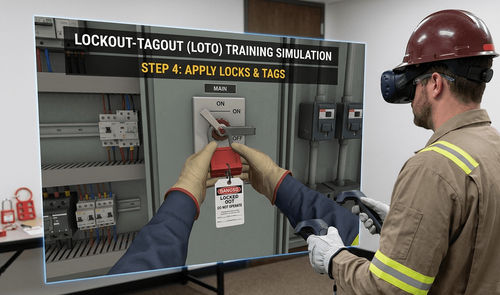
In a VR isolation module, the trainee is standing in front of a specific machine in their own plant — the actual panel layout, the actual isolation points, the actual signage and floor markings.
They must identify every energy source present. Not select from a list, but physically locate and address each one. The hydraulic accumulator that is easy to overlook is there, in the place it actually is, and if it is not bled the simulation will demonstrate the consequence.
They must select and apply the correct lock and tag, in sequence, and complete verification. If they skip the try-step, the scenario proceeds and then shows them exactly what a live machine does to a hand inside a guard. Not a photograph of an outcome. The outcome, at the moment their decision produced it.
Then the conditions vary. The same procedure under time pressure with a supervisor asking when the line will be back. The same procedure as part of a multi-person group lockout where locks must be coordinated. The same procedure at shift handover, where someone else's lock is already applied and the trainee has to decide what is and is not permissible. The same procedure on unfamiliar equipment they have not isolated before.
That variation is the entire point. Competence in isolation is not the ability to execute the sequence once in ideal conditions. It is the ability to execute it reliably when conditions are not ideal — which is precisely when incidents occur.
Consequence without harm
There is a specific reason procedural simulation works for energy isolation, and it is worth stating directly because it explains the retention difference.
In real operations, a skipped verification step usually produces no consequence at all. The machine was in fact isolated. Nothing happens. The worker's shortcut is silently rewarded, and gets repeated. Over months, the shortcut becomes the normal method. This is how procedural drift happens in every industrial organisation, and it is entirely rational at the individual level — the behaviour has never once produced a bad outcome.
Then one day the conditions differ, and it does.
Simulation inverts this. In VR, the shortcut produces the consequence immediately and every time. The worker experiences the outcome that would otherwise have arrived once in ten thousand repetitions, at the exact moment the decision was made. That connection between decision and consequence, felt rather than described, is what builds the reflex to verify.
It is also why the training has to be repeatable. A single exposure creates awareness. Repeated practice creates the automatic behaviour that holds up under pressure.
What becomes measurable
The compliance value of simulation-based isolation training is considerable, and often the thing that persuades an EHS function.
Classroom LOTO training produces attendance records and a written test score. Neither tells you whether a worker can actually isolate a machine safely.
Simulation produces behavioural data. Which energy sources were identified and which were missed, on which equipment. Whether verification was performed or skipped, and whether it was skipped more often under the time-pressure variant. Where in the sequence errors cluster. How many attempts a worker needed to reach competency. Whether performance decayed since the last assessment.
This changes what your training function can do. Instead of a certification list, you have a competency map — visible by worker, by equipment type, by site, by shift. If your Vizag plant misses stored hydraulic energy at three times the rate of your Jamshedpur plant, that is a specific, actionable finding you could not have surfaced from a register.
It also strengthens your position considerably in a regulatory inspection or a post-incident investigation. Demonstrating that a worker completed an assessed, scenario-based competency evaluation on that specific equipment, with recorded performance data, is a materially different evidentiary position than producing a signed attendance sheet.
Practical scoping notes
If you are considering an isolation module as a first VR project, a few things matter.
Choose the equipment family that carries the highest combination of isolation complexity and workforce exposure. Modules built around a machine that only four technicians ever touch will not generate the trainee volume that makes the economics work.
Build the variants, not just the base procedure. A single ideal-conditions walkthrough is a demo. The time pressure, group lockout, handover and unfamiliar-equipment variants are where the training value sits, and they should be scoped in from the start rather than added later.
Include contractors in your trainee population from day one. Contract maintenance workers frequently carry the highest isolation exposure and receive the least consistent training, and they are routinely left out of the initial scope.
Validate against your actual isolation points with your own engineers. A generic LOTO simulation with a generic machine teaches a generic sequence. The recognition skill that prevents incidents is equipment-specific, and it only transfers if the simulated equipment matches the real one.
The bottom line
Energy isolation is a procedure that people know and still get wrong, which means more documentation and more classroom repetition of the same content is unlikely to change the outcome.
What changes the outcome is practice — enough repetitions, under enough varied conditions, with immediate and unambiguous feedback, that correct isolation becomes automatic rather than deliberate.
That is difficult to arrange on live equipment, for obvious reasons. It is straightforward to arrange in simulation.
The organisations seeing real movement in their isolation incident data are not the ones with better LOTO documentation. They are the ones that stopped treating isolation as knowledge to be transferred and started treating it as a skill to be built.
EDIIIE has been building enterprise-grade VR, AR, and Digital Twin simulation solutions for industrial training for over a decade. With 170+ projects delivered and 800+ VR experiences built for organisations including ISRO, DRDO, Hindalco, Tata Projects, and DMRC, we build process-accurate safety simulations validated by your own engineers and deployed across multi-site operations. Talk to us about your training challenge."