Building the Internal Business Case for VR Training: A CFO-Ready Framework

"How to build an internal case that survives the finance review, not just the demo.
The demo goes brilliantly. The plant head puts on the headset, walks through the confined space scenario, takes it off, and says some version of ""this is exactly what we need.""
Six weeks later the proposal is still sitting with finance.
This is the most common way VR training programmes die in Indian industry. Not rejection. Not a competitor. Just a business case that convinced an operations audience and could not survive a finance one, quietly running out of momentum somewhere between enthusiasm and approval.
The gap is not that finance teams are obstructive. It is that safety and L&D teams typically build the case in the language of capability, and finance evaluates in the language of capital allocation. The two are translatable. Most people just never do the translation.
Here is how to do it.
Start by accepting what finance is actually asking
When a CFO pushes back on a VR training proposal, the question is almost never ""does this work?"" The published research on immersive learning is not seriously contested any more.
The questions are:
What are we not doing if we do this? Every rupee has an alternative use, and yours is competing against a new line, a maintenance backlog, an ERP upgrade.
What is the cash timing? A ₹40 lakh outflow this quarter against benefits accruing over three years is a different proposition from the same total spread differently.
What happens if the benefits do not materialise? What is the downside case, and what is the residual value of the asset?
How will we know whether it worked? A benefit nobody can measure after the fact will not be counted before the fact either.
A business case that answers these four questions directly will clear a finance review far more reliably than one built around retention statistics.
The four benefit categories, and their credibility ranking
Not all benefits are equally persuasive. Order your case by how defensible each number is, and lead with the hardest.
Category one: avoided production downtime. This is your strongest number because your plant already tracks it. If safety induction currently pulls forty workers off the floor for two days, that is 640 production hours. Your finance team already knows what a production hour is worth. Multiply. This benefit is measurable, uncontroversial, and typically larger than people expect.
Category two: direct training delivery cost. Instructor time, travel and accommodation for multi-site delivery, venue, materials, external trainer fees. Pull three years of actuals from your training cost centre. Multi-site organisations are usually surprised at the travel and logistics line — it is often the largest single component and the easiest to eliminate.
Category three: incident cost reduction. Powerful but harder to defend, because you are forecasting the absence of events. Handle it by anchoring on your own historical data rather than on industry averages. Take your actual recordable incidents over the last three years, cost them fully — medical, downtime, investigation time, regulatory exposure, replacement labour, insurance impact — and then apply a deliberately conservative reduction assumption. If published deployments report 40 to 60 percent reductions, model 25 percent. A case that survives pessimistic assumptions is far more persuasive than one that needs optimistic ones.
Category four: competency and throughput gains. Faster time-to-productive for new hires, higher first-attempt certification rates, standardised competency across sites. Real, and often the largest long-run value, but the hardest to convert into a defensible rupee figure. Present it as supporting narrative rather than as a line in the NPV. Do not let a soft number contaminate a hard case.
Build the comparison correctly
The single most common error in these business cases is comparing VR against zero. VR is not being compared against not training. It is being compared against your current training method, which has a cost you are already paying.
Construct two columns over the same period, typically three to five years.
The status quo column carries instructor cost, travel, downtime, materials, facility, refresher cycles, and expected incident cost at current rates. The VR column carries content development, hardware, deployment, integration, annual maintenance, hardware refresh in year three, internal ownership time, and expected incident cost at the reduced rate.
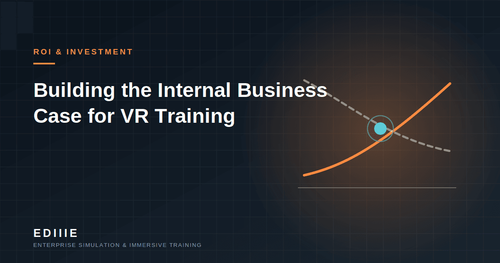
Then compare cumulative outflow year by year. This is the chart that gets approvals — not a retention statistic, but two lines crossing.
For most industrial deployments they cross somewhere in year two.
Model the trainee volume honestly
Your break-even is driven almost entirely by how many people go through the module. Content cost is fixed; the more trainees, the lower the cost per head.
This means the module you choose first matters enormously to the economics. A specialised procedure trained on twelve people a year will not produce compelling numbers. The same investment in an induction or high-frequency safety module running 800 workers annually will.
Count carefully: new hires per year, refresher cycle frequency, contractor workforce, and multi-site totals. Contractors are routinely omitted and often represent the largest population with the highest incident exposure.
Cost parity with classroom delivery typically arrives somewhere between 200 and 400 trainees on a given module. If your first module cannot reach that in eighteen months, pick a different first module.
Give finance the downside case before they ask for it
This one tactic materially improves approval rates, and almost nobody does it.
Present three scenarios. Base case with your conservative assumptions. Upside with published benchmark performance. And a downside that assumes the incident reduction never materialises at all — only the hard, verifiable benefits of downtime and delivery cost count.
If the downside case still shows payback within three years on downtime savings alone, you have removed the primary objection before it is raised. You have also signalled that you are not selling. Finance teams respond to that.
Name the measurement plan upfront
Commit, in the proposal, to what you will report and when. Something like: baseline captured pre-deployment, then quarterly reporting on trainees completed, average competency score, time-to-competency versus baseline, near-miss reports in the trained population, and training hours saved.
Two things happen when you do this. Finance sees a mechanism for holding the investment accountable, which reduces perceived risk. And you build the evidence base for the second phase of funding, which is where most programmes actually stall — not at the first approval but at the expansion request, when nobody captured a baseline and there is nothing to compare against.
Capture the baseline before deployment. Once the headsets arrive, the counterfactual is gone forever.
Structure the ask to match the risk
Do not request the full multi-site programme in the first paper.
Request a scoped pilot with defined success criteria and a pre-agreed decision gate. Something like: one module, one site, defined trainee population, six-month evaluation, expansion contingent on hitting stated thresholds.
This converts a large irreversible commitment into a small reversible one, which is a fundamentally easier approval. It also means the expansion request arrives supported by your own operational data rather than a vendor's case study — a much stronger paper, and one that typically moves faster than the first.
The one-page structure that works
Finance teams read the first page. Structure accordingly.
Open with the problem in operational terms and its current annual cost. State the proposed intervention in one paragraph. Show the three-scenario financial summary with payback period and the cumulative cost comparison chart. State the measurement commitments and the decision gate. Put the technology detail, vendor evaluation, and research citations in appendices.
If your business case opens with an explanation of what virtual reality is, it will be read as a technology purchase. It is not. It is a workforce risk and productivity investment that happens to use a headset. Frame it that way from the first line.
The bottom line
The organisations that get immersive training funded are rarely the ones with the most impressive demo. They are the ones that translated the demo into the language their finance function actually uses — cash timing, alternative use of capital, downside protection, and measurable accountability.
The underlying case for high-consequence training is strong enough to survive conservative assumptions. Most proposals fail not because the economics are weak but because they were never presented as economics.
Build the two-column comparison. Model the downside. Commit to the measurement. Capture the baseline before you deploy.
Then the approval takes care of itself.
EDIIIE has been building enterprise-grade VR, AR, and Digital Twin simulation solutions for industrial training for over a decade. With 170+ projects delivered and 800+ VR experiences built for organisations including ISRO, DRDO, Hindalco, Tata Projects, and DMRC, we work with client teams to build the internal business case — including baseline capture, scenario modelling, and pilot success criteria. Talk to us about your training challenge."