VR vs AR vs MR: Which Immersive Technology Fits Your Training Problem?

The technology is not the starting point. The training problem is.
A training manager at an automotive plant gets approval to explore immersive technology. She starts researching and immediately runs into a wall of acronyms. VR. AR. MR. XR. Extended Reality. Spatial Computing. Every vendor claims their technology is the answer. Every demo looks impressive. But none of them answer the question she actually has: which one will fix the specific problem on her shop floor?
This confusion is more common than any vendor will admit. The immersive technology market has grown fast, and the marketing has outpaced the education. Decision-makers are being asked to choose between technologies they do not fully understand, for use cases they have never seen implemented, with budgets that need to be justified to boards that are even less informed than they are.
So let us slow down and lay this out clearly.
What does each technology actually do?
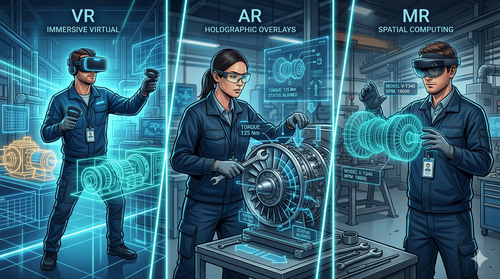
Virtual Reality places the trainee inside a fully computer-generated environment. They put on a headset and the real world disappears. They are standing in a virtual smelter, or a virtual oil rig, or a virtual operating theatre. Everything they see, hear, and interact with is simulated. The environment responds to their actions. If they turn a valve, fluid flows. If they skip a safety check, an alarm sounds. If they make a critical error, they see the consequences unfold in front of them. Safely.
VR is at its best when the training scenario is too dangerous, too expensive, or too logistically difficult to practise in reality. Emergency evacuations. Equipment failures. Chemical spills. High-voltage switching operations. Confined space entry. These are situations where you need workers to build decision-making reflexes, but you cannot afford to let them learn through trial and error on live equipment.
Augmented Reality does something fundamentally different. The trainee stays in the real world. They look at real equipment, in their real workplace. But through a tablet, phone, or headset, they see digital information layered on top of what is physically in front of them. Step-by-step instructions hovering next to the machine they are servicing. Arrows pointing to the correct bolt sequence. Safety warnings that appear when they approach a hazard zone. Performance data overlaid on the equipment in real time.
AR is at its best when the worker needs guidance while performing a real task. Maintenance procedures. Assembly sequences. Quality inspection checklists. Equipment setup. The value is not in simulating an experience but in augmenting a real one, reducing errors and removing the need to constantly refer back to a manual or a training video.
Mixed Reality sits between the two, and this is where the terminology gets muddied. In MR, digital objects are placed into the real environment and behave as though they belong there. A virtual turbine component appears on a real workbench, and the trainee can walk around it, examine it from different angles, even manipulate it with hand gestures. Unlike AR, which typically overlays flat information, MR creates three-dimensional digital objects that are spatially anchored to the physical world.
MR is at its best for collaborative scenarios. Design reviews where engineers from multiple locations examine a virtual prototype placed on a real conference table. Training scenarios where a virtual instructor demonstrates a procedure on real equipment. Complex maintenance where a technician needs to see inside a machine, virtually, while standing next to the actual unit.
What mistake do most buyers make?
Here is where most evaluation processes go wrong. The buyer starts with a technology preference instead of a training problem.
They see a VR demo and think, "We need VR." But their actual problem might be that maintenance technicians keep making errors during turbine inspections because the procedure manual is 200 pages long and nobody reads it in the field. That is an AR problem, not a VR problem. What they need is contextual, on-the-job guidance, not an immersive simulation.
Or they attend a conference, see a Mixed Reality headset, and decide that is what they want. But their actual challenge is that new hires at their chemical plant take nine months to become fully competent because they cannot practise emergency scenarios safely. That is a VR problem. MR is overkill for it.
The technology choice should follow from three questions. First, what is the training scenario? Is it a high-risk situation that cannot be practised in real life, or is it a routine procedure that workers perform regularly but inconsistently? Second, where does the training happen? Is it in a dedicated training room, or does it need to happen on the shop floor during live operations? Third, what outcome are you measuring? Are you trying to build decision-making reflexes for rare critical events, or are you trying to reduce error rates on everyday tasks?
When VR is the right answer
VR earns its place when the training scenario meets at least one of these conditions: practising it in real life is genuinely dangerous, the cost of real-world practice is prohibitive, or the scenario is so rare that workers never get enough repetitions to build competence.
Industrial safety training is the most obvious example. A worker at an aluminium smelter needs to know exactly what to do if molten metal splashes during an anode change. You cannot splash molten metal at a trainee to teach them. VR lets you do exactly that, repeatedly, until the response is automatic.
Equipment operation training for high-value machinery is another strong case. Training a new operator on a real CNC machine means that machine is not producing parts. Training them in VR means the production line keeps running and the trainee can make mistakes without damaging equipment worth crores.
Emergency response drills are perhaps the most compelling use case. You cannot set a real fire in your plant to test evacuation procedures. You cannot simulate a real gas leak. VR can reproduce these scenarios with complete fidelity, test worker responses under pressure, and provide objective data on who responded correctly and who did not.
When AR is the right answer
AR excels at a completely different type of training challenge: the ongoing, on-the-job kind. Not the dramatic emergency scenario, but the daily procedure that needs to be done correctly every single time.
Think about a maintenance technician servicing a transformer. The procedure has 47 steps. The order matters. The torque specifications matter. The safety interlocks need to be verified at specific points. In the traditional model, the technician either memorises the procedure, carries a paper manual, or calls a supervisor. With AR, they look at the transformer through a headset and the steps appear in sequence, spatially anchored to the correct components. They cannot skip ahead. They cannot miss a step. The guidance is right there, on the equipment, in context.
Quality inspection is another area where AR is proving its value. Instead of relying on an inspector's memory of what to check, AR overlays the inspection criteria directly onto the product or component being examined. Tolerances, surface finish requirements, assembly verification points, all visible in real time, exactly where they are relevant.
Remote expert assistance is a third use case that has grown significantly. A junior technician in a plant in Vizag can wear AR glasses and share their field of view with a senior engineer in Jaipur. The senior engineer can draw annotations, highlight components, and guide the repair in real time. The knowledge transfer happens in context, not through a phone call where both parties are guessing what the other one is looking at.
When MR is the right answer
Mixed Reality is the newest and least deployed of the three, but it has clear advantages for specific use cases.
Design and engineering reviews are perhaps the strongest. When a new facility is being planned, or a new production line is being designed, stakeholders need to understand spatial relationships. How will the equipment fit in the available space? Where should the emergency exits be relative to the high-risk zones? What does the operator's sight line look like from the control panel? MR lets teams place virtual equipment in real spaces at full scale and walk through the design as though it already exists.
Complex maintenance training is another fit. When a technician needs to understand the internal structure of a sealed machine, what is behind the panel, where the wiring runs, how the components connect, MR can make the machine virtually transparent. The trainee sees the real machine in front of them, but with digital overlays showing internal components, flow paths, and connection points that would normally be invisible.
Collaborative training scenarios benefit from MR as well. Multiple trainees, possibly in different locations, can gather around a shared virtual object placed in their respective real environments. They can discuss, point to components, and manipulate the virtual model together. This is particularly valuable for organisations with globally distributed teams who need to align on technical standards.
The case for using more than one
The most effective enterprise deployments we have seen do not choose one technology. They use different technologies for different stages of the training lifecycle.
VR for initial competency building. Workers learn the process, build muscle memory, and practise critical scenarios in a safe simulated environment. AR for on-the-job performance support. Once workers are on the floor, AR provides real-time guidance to reinforce what they learned in VR and reduce errors during actual operations. MR for advanced collaboration and continuous improvement. Engineers use MR for design reviews, cross-site knowledge sharing, and complex troubleshooting that requires seeing inside equipment.
This layered approach means the training investment compounds over time. The VR simulation content informs the AR guidance overlays. The data from AR field usage identifies where additional VR training scenarios are needed. The MR design reviews improve the fidelity of both the VR simulations and the AR procedures. Each technology feeds the others.
What this means for your decision
If you are evaluating immersive training for the first time, start with the problem, not the technology. Map your highest-risk, highest-cost, or highest-error-rate training scenarios. Identify which ones are about building reflexes for rare critical events (VR), which ones are about reducing errors on routine tasks (AR), and which ones are about improving collaboration and spatial understanding (MR).
Then start with the one that addresses your most urgent operational pain point. Build the business case around measurable outcomes for that specific use case. Deploy, measure, and prove the value. Then expand.
The technology ecosystem is mature enough that you do not need to make a single bet. But you do need to make a smart first move. And that starts with understanding what each technology is actually designed to do, and, equally importantly, what it is not.
EDIIIE designs and deploys VR, AR, and MR solutions across all three dimensions of immersive training. With 170+ enterprise projects delivered across manufacturing, defence, healthcare, oil and gas, and infrastructure, we help organisations choose the right technology for the right problem. Talk to us about your training challenge.