Why Most VR Training Pilot Projects Die After Six Months (And How to Design One That Doesn't)

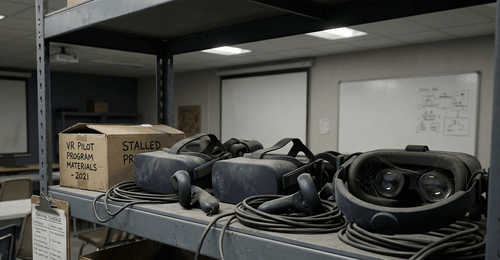
The pilot rarely fails on technology. It fails on design decisions made before anyone put on a headset.
The pattern is remarkably consistent.
A company runs a VR training pilot. It goes well. Workers are engaged, the leadership walkthrough impresses everyone, the internal newsletter carries a photograph of someone in a headset. Then, gradually, usage tails off. The headsets end up in a cupboard in the training room. Eighteen months later, someone asks what happened to the VR project and nobody has a clear answer.
Very few of these failures are technology failures. The simulation usually worked. What failed was the design of the pilot itself — a set of decisions taken before procurement that made the transition from pilot to programme structurally impossible.
The good news is that these decisions are identifiable in advance. Here are the ones that matter.
Failure one: the pilot was designed to impress, not to prove
The most common mistake is choosing the pilot use case for demonstration value rather than operational value.
Someone selects the most visually dramatic scenario — a fire, an explosion, a spectacular equipment failure — because it will land well in a leadership demo. It does land well. But it trains a low-frequency event for a small population, generates no meaningful operational data, and produces no evidence that justifies scaling.
The pilot then succeeds as an event and fails as an experiment. There is nothing to expand on, because nothing measurable happened.
Choose instead the use case with the clearest business case and the highest trainee volume. High-frequency, high-consequence, large population. Induction safety. Isolation procedures. A core equipment operation that hundreds of workers perform. Less impressive in a demo; far more likely to produce numbers that get phase two funded.
Failure two: no baseline was captured
This one is fatal and irreversible.
At the end of the pilot, someone asks whether training outcomes improved. The team discovers that nobody recorded what the outcomes were before. There is no pre-deployment measure of time-to-competency, no baseline assessment score under comparable conditions, no clean incident or near-miss rate for the target population, no accurate figure for current training delivery cost.
Without a baseline, the pilot can only produce testimonials. Testimonials do not survive a finance review.
Capture the baseline before the headsets arrive. Time-to-competency under the current method, current assessment scores, current delivery cost per trainee including downtime and travel, and near-miss and incident rates in the target population for the preceding period. It takes a few weeks of effort and it is the difference between an expansion proposal built on data and one built on enthusiasm.
Once deployment begins, the counterfactual is gone permanently.
Failure three: nobody owned it
Pilots run on the energy of whoever championed them. When that person is busy, on leave, or reassigned, the programme stops — because in most pilots nobody's actual job description includes running it.
VR training has real operational overhead. Sessions need scheduling around shift patterns. Headsets need charging, cleaning and periodic updating. Trainers need to be comfortable running sessions unsupported. Someone has to look at the analytics and act on them. None of this is difficult, but all of it requires a named person with allocated time.
Name that person before the pilot starts, and put the responsibility in their objectives. A programme that depends on goodwill will last exactly as long as the goodwill does.
Failure four: the technology was placed where the workers are not
Headsets get installed in the corporate training room, or the L&D office, or wherever there is space. Which means every training session requires workers to leave the production area, walk across the site, and go somewhere they do not normally go.
That friction is small per session and decisive in aggregate. Utilisation quietly declines, and the decline gets attributed to lack of interest rather than to a fifteen-minute walk.
Put the equipment where the workers already are. Near the shop floor, in the shift briefing area, somewhere accessible during natural gaps in the working day. Deployments that treat VR as something workers come to consistently underperform deployments that bring it to them.
Failure five: it was never integrated into the training calendar
If VR training remains an optional supplementary activity, it will be the first thing dropped when production pressure rises. And production pressure always rises.
The pilots that survive are the ones where the simulation replaced a specific existing training obligation rather than adding to it. The VR module is not extra practice before the classroom induction — it is the induction, or a defined component of it, with completion required for certification and recorded in the same system as everything else.
This has to be decided at pilot design stage, in coordination with whoever owns the compliance training calendar. Retrofitting it afterwards is far harder, because by then it is established in everyone's mind as the optional thing.
Failure six: success criteria were never agreed
Ask three stakeholders what would make the pilot a success and you frequently get three different answers. Operations wants reduced training downtime. EHS wants incident reduction. L&D wants completion rates and engagement. Finance wants cost per trainee.
Without agreed criteria, the evaluation becomes an argument. Every stakeholder assesses against their own unstated standard, and the ambiguity is usually resolved by inertia — which means no expansion.
Write the criteria down before deployment, with specific thresholds and a specific decision date. Something like: 250 workers trained within six months, average competency score above an agreed threshold, time-to-competency reduced by a stated percentage against baseline, cost per trainee below the current method by month nine, expansion decision taken at month seven with named decision-makers.
Circulate it. Get agreement. A pre-agreed decision gate converts a vague continuation question into a straightforward yes or no.
Failure seven: scale was not architected in
Some pilots succeed on their own terms and still cannot expand, because the content and deployment architecture was built for one site and one context.
The signs are recognisable. Content that requires the vendor to rebuild rather than reconfigure for a different plant layout. No device management capability, so scaling from twenty headsets to three hundred means manually updating each one. No LMS integration, so training records live in a standalone tool nobody else can see. Licensing terms priced for a pilot that become uneconomic at workforce scale.
Ask the scaling questions during procurement, not after the pilot succeeds. What changes when we go from one site to fifteen? How does content reach a new location? How are devices managed centrally? What does the commercial model look like at 5,000 trainees? A vendor built for enterprise deployment will answer these readily. One built for pilots will improvise.
What a well-designed pilot looks like
Pulling it together, the pilots that convert into programmes tend to share the same shape.
One module, chosen for business case strength and trainee volume rather than visual impact. One site, chosen for operational stability and a supportive plant leadership team. A defined trainee population large enough to produce statistically meaningful results, typically 200 or more. A named internal owner with allocated time. A documented baseline captured before deployment. Written success criteria with thresholds and a decision date agreed across operations, EHS, L&D and finance. Equipment located where the workforce already works. The module substituting for an existing training requirement rather than supplementing it. And an architecture and commercial model already validated for multi-site scale.
None of this is expensive. Most of it is a few weeks of design work before procurement.
The bottom line
The failure rate of enterprise VR training pilots is high, and it has very little to do with whether immersive learning works. The evidence on that is settled.
Pilots fail because they are designed as demonstrations rather than as experiments — chosen for impact, run without a baseline, owned by nobody in particular, evaluated against criteria that were never agreed, and architected in a way that made expansion impractical.
Every one of those is a design decision, and every one is reversible before you start and expensive to fix afterwards.
Spend the extra month on pilot design. It is the highest-return work in the entire programme.
EDIIIE has been building enterprise-grade VR, AR, and Digital Twin simulation solutions for industrial training for over a decade. With 170+ projects delivered and 800+ VR experiences built for organisations including ISRO, DRDO, Hindalco, Tata Projects, and DMRC, we design pilots around defined success criteria and multi-site scaling architecture from day one. Talk to us about your training challenge.