Why Aerospace MROs Are Adopting VR for Maintenance Training: What DGCA and EASA Compliance Looks Like

Every hour an aircraft spends being used for training is an hour it is not earning revenue. VR changes that equation entirely.
Aviation maintenance is one of the most precisely regulated activities in any industry. Every task has a documented procedure. Every procedure has a competency standard. Every competency standard has an assessment requirement. And every assessment is subject to regulatory scrutiny from bodies like India's DGCA, the European Aviation Safety Agency (EASA), and the FAA. The margin for error is not thin, it is effectively zero. A maintenance error that goes undetected can become an airworthiness defect that puts lives at risk.
This regulatory precision creates a training challenge that is unique to aerospace. It is not enough for a technician to know how to perform a procedure. They must be able to demonstrate, in a documented and verifiable way, that they can perform it to the standard required by the applicable regulation. And they must do this for a wide range of tasks, across multiple aircraft types, on a recurring basis.
Traditionally, this training has required access to real aircraft. Technicians practise on live airframes in hangars, supervised by authorised instructors, using the actual tools and equipment they will use on the line. This approach works. It has worked for decades. But it is becoming increasingly difficult to sustain, for reasons that have nothing to do with the quality of the training and everything to do with the economics and logistics of making aircraft available for it.
Key takeaways
- VR maintenance training reduces dependence on scarce, revenue-generating aircraft for practice.
- Scenarios can be aligned to DGCA and EASA Part-66 and Part-147 competency requirements.
- It suits engine inspection, procedure rehearsal, and AMM-driven task training.
- Digital training records strengthen audit readiness and technician competency tracking.
The aircraft availability problem
An aircraft sitting in a hangar for training is an aircraft that is not flying. For airlines and MRO organisations, aircraft utilisation is a fundamental business metric. Every hour of downtime has a direct cost, both in lost revenue and in hangar occupancy. Allocating training time on live aircraft means competing with maintenance schedules, customer commitments, and operational requirements.
For training organisations approved under DGCA CAR-147 or EASA Part-147, the problem is even more acute. They need to maintain training aircraft in a specific configuration, often for multiple aircraft types, with the associated maintenance and storage costs. As their student intake grows, the demand for aircraft access grows proportionally, but the fleet does not scale at the same rate.
This bottleneck constrains training throughput. Programmes that could accept more students cannot do so because the practical training slots are full. Technicians who need to train on a new aircraft type may wait weeks for hangar time. Refresher training and recurrent assessments compete with initial training for the same limited aircraft access.
VR simulation breaks this constraint entirely. A VR-based aircraft maintenance trainer can be used twenty-four hours a day, seven days a week. It does not require hangar space, aircraft downtime, or tooling logistics. It scales with the number of headsets, not the number of available aircraft. And it can simulate aircraft types that the organisation does not physically have on site.
What VR aircraft maintenance training actually looks like
A VR maintenance training simulation for aerospace is not a generic aviation environment with approximate controls. It is a photorealistic, dimensionally accurate replica of a specific aircraft type, built from manufacturer data and validated against the actual Aircraft Maintenance Manual (AMM).
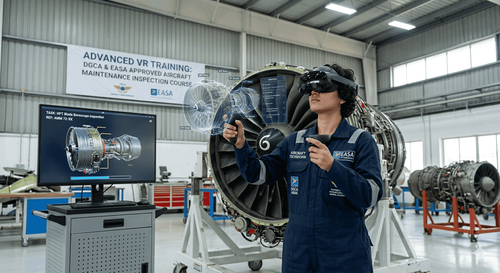
The technician puts on a VR headset and finds themselves standing in a virtual hangar next to the aircraft they will be maintaining. The access panels are in the correct locations. The fastener types are accurate. The tool sizes match the real specifications. They can open panels, remove components, inspect surfaces, and follow the AMM procedure step by step, with the simulation tracking their actions at each stage.
The training is typically structured in three modes. Learn mode walks the technician through the procedure with narrated guidance, highlighting each step, identifying the correct tools, and explaining the safety considerations. Practice mode lets the technician attempt the procedure independently, with the option to request hints if they get stuck. Assessment mode removes all guidance and records the technician's performance, every action, every sequence, every error, generating a competency report that can be reviewed by the instructor and filed as a training record.
This three-mode architecture is not arbitrary. It maps to how competency-based training works under DGCA and EASA frameworks. The trainee progresses from guided instruction through independent practice to assessed performance, with documented evidence at each stage.
The regulatory alignment question
The question that every aviation training manager asks about VR is whether the regulator will accept it. The answer is more nuanced than a simple yes or no, and it is evolving.
Neither DGCA nor EASA currently mandate VR as a training delivery method, nor do they prohibit it. The regulations specify competency outcomes, not delivery technologies. What matters to the regulator is whether the training programme produces technicians who can demonstrate the required competencies, whether the assessments are valid and documented, and whether the training organisation can show evidence that its methods achieve the stated outcomes.
VR training fits within this framework when it is designed to align with the specific task competency units defined in the regulations, when the assessment criteria in the VR system map to the regulatory assessment standards, and when the training records generated by the VR system meet the documentation requirements for regulatory audit.
The critical distinction is between knowledge training, procedural training, and hands-on practical training. VR is highly effective for the first two, building understanding of aircraft systems and practising maintenance procedures in a realistic but risk-free environment. For hands-on practical training, where the technician must demonstrate that they can physically perform a task on real equipment (applying correct torque, interpreting tactile feedback from real materials, working with actual fluid systems), VR serves as preparation rather than replacement.
The most effective implementations use VR to ensure that when technicians arrive for their limited hands-on practical sessions, they already know the procedure, the tool sequence, the safety requirements, and the common error points. This means the practical session can focus on the physical skills that require real equipment, rather than spending time on procedural orientation that VR has already delivered. The result is that the same amount of aircraft access produces significantly higher training outcomes.
Specific training applications where VR excels in MRO
Several categories of maintenance training are particularly well suited to VR delivery, and MRO organisations that have deployed VR are typically starting with these.
AMM procedure walkthroughs are the most common starting point. Complex maintenance procedures, engine access, landing gear servicing, flight control system checks, involve dozens of sequential steps with specific tooling, torque specifications, and safety checks. In VR, the technician can walk through the entire procedure at their own pace, repeat any section, and verify their understanding before touching a real aircraft. The simulation can highlight components that are difficult to see or access in the real environment, providing visual perspectives that are not available from any physical vantage point in the hangar.
Component inspection training is another strong application. Training inspectors to identify corrosion, crack propagation, wear patterns, and other defects requires exposure to a wide range of defect types at varying stages of progression. Physical samples are expensive to maintain and limited in variety. VR can present an unlimited range of defect conditions on virtual components, training the inspector's eye to recognise subtle variations that might indicate an airworthiness concern. The simulation can also test the inspector's ability to correctly categorise defects and determine the appropriate maintenance action, condemn, repair, or continue in service.
Foreign Object Damage prevention training addresses one of the most persistent safety concerns in MRO operations. FOD events, a tool left in an intake, a fastener dropped in a fuel tank, a rag forgotten in a control bay, can have catastrophic consequences. VR training simulates the complete tool accountability cycle: tool selection, usage, verification, and return. The simulation tracks whether the technician accounts for every tool and consumable, reinforcing the disciplined habits that prevent FOD incidents in real operations.
Hangar safety and ground handling training covers the human factors aspects of working in a hangar environment: awareness of propeller and intake hazard zones, correct aircraft marshalling procedures, hangar fire response, and hazardous material handling. These scenarios involve spatial awareness and decision-making under time pressure, exactly the competencies that benefit most from immersive, experiential training.
The training record advantage
One of the underappreciated benefits of VR-based maintenance training is the quality and granularity of the training records it generates. In traditional practical training, the assessment is typically recorded as a pass or fail by the supervising instructor, possibly with brief written notes on areas needing improvement. The instructor's assessment is necessarily subjective and limited by their ability to observe every action the trainee takes.
VR assessment records are comprehensive, objective, and timestamped. The system records every action: when the technician selected a tool, which tool they selected, whether they verified the torque setting, whether they followed the correct sequence, how long each step took, and where they made errors. This data is available not just as a pass-or-fail outcome but as a detailed performance map that identifies specific areas of strength and weakness.
For regulatory audits, this level of documentation is powerful. The training organisation can demonstrate, for any individual technician, exactly what training they received, how they performed on each assessed task, where they needed additional practice, and how their competency developed over time. This is a fundamentally higher standard of training evidence than a signed logbook entry.
It also enables data-driven training management. If the VR assessment data shows that forty percent of technicians are making errors on step seven of a particular procedure, the training manager knows exactly where to focus attention. The procedure itself might need clarification, or the training content for that step might need enhancement. Without granular performance data, these patterns remain invisible.
Economic impact for MRO organisations
The financial case for VR training in MRO is driven by three factors. First, reduced aircraft downtime for training. If a VR programme reduces the number of hours each technician needs to spend training on live aircraft by fifty percent, the recovered aircraft availability has direct revenue value. For an MRO billing hangar time at commercial rates, the saving is immediate and measurable.
Second, increased training throughput. VR stations can operate continuously and in parallel. An MRO that could previously train three technicians per day on live aircraft can train ten or more per day in VR, with each technician spending less calendar time in training because the procedural preparation has already been completed before they touch the real aircraft.
Third, reduced risk of training-related damage. Every training session on a live aircraft carries a non-zero risk of damage: scratched surfaces, over-torqued fasteners, dropped tools, incorrectly replaced panels. These incidents are rarely catastrophic, but the cumulative cost of repair, rework, and quality checks is a real line item. VR training eliminates this category of cost entirely, the virtual aircraft can be damaged a thousand times without consequence.
Where this is heading for Indian aviation
India's aviation sector is growing rapidly. The fleet is expanding, MRO capacity is scaling to meet demand, and the requirement for qualified maintenance personnel is increasing proportionally. DGCA's regulatory framework is evolving to accommodate new training technologies, and the global trend toward simulation-based maintenance training is well established in markets that India's aviation sector benchmarks against.
MRO organisations that invest in VR training infrastructure now will have a structural advantage as the industry scales: higher training throughput, lower per-technician training cost, better regulatory documentation, and a training model that scales with the number of headsets rather than the number of available aircraft.
The question is not whether VR will become standard in aerospace maintenance training. The question is which organisations will build the capability first and establish it as a competitive differentiator before it becomes a table-stakes requirement.
Related reading and resources
- VR Training Solutions
- Hardware-Integrated Simulators
- Aerospace
- Hardware-Integrated Simulators: When Headsets Are Not Enough
- What a VR Training Deployment Looks Like
- How to Measure Immersive Training Effectiveness
EDIIIE builds full-scale VR aircraft maintenance simulators for MRO organisations, training academies, and airlines. Our work with EASA-certified MRO organisations has validated a dual-mode training architecture that aligns with DGCA CAR-66 and EASA Part-66 competency standards. Talk to us about your training challenge.