What a VR Training Deployment Actually Looks Like: From Site Survey to Go-Live

The biggest barrier to VR training adoption is not cost or technology. It is uncertainty about the process.
When a training manager or an EHS head sees a VR training demonstration, the reaction is almost always the same. They are impressed. They can see how it would work for their team. They want to explore it further. And then they get back to their desk and realise they have no idea what happens next.
How do we actually start this? Who needs to be involved? What do we need to provide? How long will it take? What does the team on the factory floor need to know? Will this work with our existing training systems? What happens if we need to change something after it is built?
These are not trivial questions. The answer to each one affects timelines, budgets, and ultimately whether the project succeeds or dies in procurement. And the uncertainty around them is one of the primary reasons VR training projects stall between "this is interesting" and "let's do it."
So let us walk through the entire process. No jargon, no sales language. Just what happens, in what order, and why.
Key takeaways
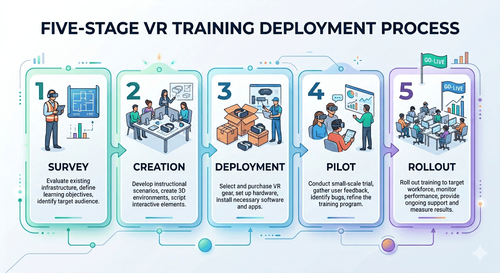
- Enterprise VR training is delivered in five stages: site survey, design, development, pilot, and rollout.
- A single module typically runs about 8 to 14 weeks from survey to go-live.
- Client input on SOPs, subject matter experts, and site access shapes fidelity and timeline.
- Deployment does not end at go-live. Analytics and content updates continue afterwards.
Stage one: understanding what you actually need
Every effective VR training project starts with a question that has nothing to do with VR: what is the training problem you are trying to solve?
This sounds obvious, but it is remarkable how often it gets skipped. An organisation decides they want VR training and immediately starts discussing headset specifications and content complexity. But the most important decisions happen before any technology is selected.
The first step is a training needs assessment. This typically involves site visits to the facility where training will be deployed, interviews with the people who actually do the training (instructors, supervisors, safety officers), analysis of existing training content and materials, review of incident and near-miss data to identify where current training is falling short, and observation of the actual work processes that the training needs to address.
The output of this phase is a clear map of training gaps: which scenarios need to be covered, which worker populations need training, what the current competency levels are, and what measurable outcomes the VR programme needs to deliver. This is the foundation that everything else is built on.
A good simulation partner will push back during this phase. If a scenario is better served by augmented reality than virtual reality, they should say so. If a training gap can be closed with a better SOP document rather than a six-figure VR simulation, they should say that too. The goal is to identify where VR adds genuine value, not to sell VR for problems it is not designed to solve.
This phase typically takes two to four weeks, depending on the number of sites and the complexity of the operations involved.
Stage two: designing the simulation
Once the training gaps are mapped, the simulation design begins. This is where the VR project starts looking different from a conventional training content project, because the design process must account for interactivity, spatial accuracy, and process fidelity, not just information delivery.
The design phase produces a detailed storyboard for each training module. The storyboard defines the virtual environment (what facility or equipment the trainee will be in), the scenario narrative (what situation unfolds), the decision points (where the trainee needs to act), the branching logic (what happens if they act correctly versus incorrectly), and the assessment criteria (what data will be captured to evaluate performance).
This storyboard is reviewed and validated by the client's subject matter experts, the process engineers, safety officers, and experienced operators who know what correct performance actually looks like. This validation step is critical. If the simulation does not accurately represent the real process, the training will teach the wrong behaviours. No amount of visual fidelity compensates for process inaccuracy.
The design phase also defines the technical specifications: target hardware platform (standalone headset, tethered headset, or large-display system), interaction modality (hand controllers, hand tracking, gaze-based), audio design (environmental sounds, voice instructions, alarm systems), and integration requirements (LMS connectivity, analytics dashboard, user management).
Design typically takes three to five weeks, including at least two rounds of SME review and revision.
Stage three: building the simulation
Development is where the simulation comes to life. This is the most resource-intensive phase and involves multiple parallel workstreams.
The 3D environment is built from reference materials gathered during the site survey: photographs, engineering drawings, equipment specifications, and sometimes laser scan data for high-precision dimensional accuracy. The goal is a photorealistic representation of the actual facility that workers will recognise as their workplace, not a generic industrial environment.
Simultaneously, the interactive logic is built: the scenario scripting, the physics interactions (how fluids flow, how equipment responds to inputs, how environmental conditions change), the assessment tracking, and the branching pathways that respond to trainee decisions.
Audio design happens in parallel as well. Industrial environments are loud, and the soundscape is a critical part of the immersive experience. The hum of equipment, the alarm tones, the voice commands from supervisors, these create the sense of presence that makes VR training feel real rather than game-like.
Throughout development, the simulation goes through multiple internal quality checks: technical performance testing (does it run smoothly on the target hardware?), process accuracy reviews (does the equipment behave correctly?), and user experience testing (is it intuitive for workers who may never have used VR before?).
Development for a single module typically takes four to eight weeks after the design is approved. Multi-module suites are developed in staggered phases, with each subsequent module building on the assets and framework established for the first.
Stage four: pilot testing and refinement
Before full deployment, every VR training module goes through a pilot phase with a representative group of end users. This is not a formality. It is one of the most valuable stages in the entire process.
The pilot serves multiple purposes. First, it validates that the simulation is usable by the actual target population. A VR experience that works perfectly for a technology-comfortable engineer may be confusing for a shop-floor worker who has never worn a headset. The pilot identifies usability issues that only surface with real users: controller interactions that are not intuitive, text that is too small to read comfortably, movement speeds that cause discomfort for some users, and tutorial sequences that need simplification.
Second, the pilot validates the training effectiveness. Workers who complete the VR training should demonstrate measurably better performance on the target competencies than workers who have not. If the VR training does not improve outcomes relative to the existing approach, it is not adding value and the content needs to be revised.
Third, the pilot tests the operational logistics. How long does it take to set up a VR training station? How many workers can be trained per day? What happens when a headset battery dies mid-session? What level of facilitation does a VR training session require? These practical questions are best answered by running the actual operation at a representative scale.
The pilot typically runs for two to three weeks with twenty to fifty users. Feedback from the pilot is consolidated, the simulation is refined, and the deployment plan is adjusted based on the operational lessons learned.
Stage five: full deployment and ongoing operation
Full deployment involves rolling the VR training out across all target sites, integrating it with existing training workflows, and establishing the ongoing operational processes that keep it running.
The hardware deployment is usually the simplest part. Current standalone VR headsets are consumer-grade in terms of setup complexity. They charge via USB, connect to Wi-Fi, and require no external sensors or computers. A VR training station needs a clear floor area of roughly two by two metres, a chair for seated experiences, a charging point, and Wi-Fi connectivity for content updates and analytics synchronisation. Content can be pre-loaded for locations with unreliable connectivity.
Integration with the organisation's learning management system is important for two reasons. First, it ensures VR training completions and competency assessments are recorded in the same system that tracks all other training. Workers and supervisors should not need to check a separate system to see VR training status. Second, it enables centralised analytics: which modules are being used, what the average competency scores are, where the common error patterns are, and how VR-trained workers compare to classroom-trained workers on operational metrics.
Administrator and facilitator training is part of the deployment. While VR training sessions require far less facilitation than classroom sessions, someone at each site needs to know how to manage the headsets, troubleshoot common issues, guide first-time users through the initial onboarding, and escalate technical problems. This is typically a half-day training session for designated site administrators.
Ongoing operations include content updates (when processes change or new scenarios are needed), hardware maintenance and replacement (headsets have a typical useful life of three to four years), analytics monitoring, and periodic effectiveness reviews to ensure the training continues to deliver measurable outcomes.
The five deployment stages at a glance
- Site survey: understand the training need, the environment, and the operational constraints.
- Design: build process-accurate scenarios validated by your subject matter experts.
- Development: create the high-fidelity 3D simulation and interactions.
- Pilot testing: validate with real users and refine before scale.
- Full deployment: roll out across sites with analytics and ongoing support.
What the timeline looks like end to end
For a single VR training module, the typical timeline from first conversation to full deployment is twelve to sixteen weeks. Needs assessment takes two to four weeks. Design takes three to five weeks. Development takes four to eight weeks. Pilot testing and refinement takes two to three weeks. Deployment takes one to two weeks.
Some of these phases overlap. Design often begins while the site survey analysis is being finalised. Hardware procurement happens in parallel with development. Facilitator training can happen during the pilot phase.
For multi-module suites, the total programme timeline extends, but subsequent modules are faster because the foundational assets (the 3D environment, the interaction framework, the assessment engine) are reusable. A three-module suite might take twenty to twenty-four weeks rather than tripling the single-module timeline.
What you need to provide as a client
The success of a VR training project depends heavily on the client's engagement during the design and validation phases. The simulation partner brings the technology and development expertise, but only you bring the domain knowledge that makes the simulation accurate.
You need to provide access to your facilities for site surveys, typically one to two days per site. You need to designate subject matter experts, process engineers, safety officers, experienced operators, who will review the storyboards and validate the simulation during development. You need to provide existing training materials, SOPs, engineering drawings, and equipment specifications that will inform the simulation content. And you need to make a representative group of end users available for pilot testing.
The single biggest risk factor in VR training projects is SME availability. When the designated experts are too busy to review storyboards or validate builds, the project timeline slips and the content quality suffers. Organisations that treat VR training development as a priority rather than a side project consistently get better outcomes on faster timelines.
After go-live: what happens next
A VR training deployment is not a one-time event. It is a capability that needs to be maintained and evolved. Processes change, and simulations need to be updated to reflect current SOPs. New equipment is installed, and virtual replicas need to be added. Incident investigations reveal new training needs, and new scenarios need to be developed. Workforce feedback identifies improvements to existing content.
The organisations that get the most value from VR training treat it as a living programme, not a project with a completion date. They review analytics quarterly, update content annually (at minimum), and expand the scenario library based on operational data. The initial deployment is the foundation. The ongoing investment is what turns it into a transformative capability.
Related reading and resources
- VR Training Solutions
- Industrial LMS
- The ROI of VR Training
- How to Measure Immersive Training Effectiveness
- VR vs AR vs MR: Which Fits Your Problem?
EDIIIE has refined this deployment process over 170+ enterprise projects across manufacturing, defence, oil and gas, healthcare, and infrastructure. Our five-stage methodology, Identify, Design, Develop, Deploy, Measure, is designed to deliver on-spec and on-time, every time. Talk to us about your training challenge.