The ROI of VR Training: How to Build the Business Case for Your Board

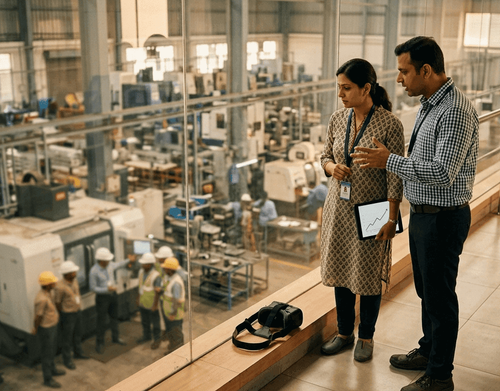
The numbers work. But only if you count the right costs.
Every conversation about VR training eventually arrives at the same question. Not "does it work?", the research on that is fairly settled. The question that actually stalls decisions is: "Can I justify this spend to the CFO?"
It is a fair question. VR training requires upfront capital investment. Custom simulation development, headsets, deployment infrastructure, integration with existing systems. The invoice is visible and immediate. Meanwhile, the costs of the training it replaces, classroom sessions, travel, production downtime, safety incidents, are spread across budgets that nobody totals up. The visible cost looks large. The invisible cost looks like business as usual.
This article is about making the invisible cost visible, and about building an ROI case that survives scrutiny from a board that is not interested in technology demos but is very interested in numbers.
Key takeaways
- Build the VR business case on measurable outcomes: cost per trainee, injury reduction, throughput, and payback period.
- Account for the hidden costs of your existing training, not just the headline price of VR.
- Savings come from fewer incidents, faster time-to-competency, and less downtime on live equipment.
- Most industrial VR programmes target payback within 12 to 18 months.
The hidden costs of the training you already have
Before calculating what VR training costs, you need to calculate what your current training actually costs. Most organisations dramatically undercount this because the expenses are distributed across different budget lines.
Start with direct costs. Instructor fees or salaries for the time they spend delivering training rather than doing their primary job. Training facility costs, the room, the equipment, the consumables. Travel and accommodation for instructors who need to visit multiple sites, or for workers who need to travel to a central training facility. Training materials: printed manuals, updated safety documents, video production.
Then add the costs that rarely appear on the training budget but are real expenses. Production downtime. When workers are in a classroom for two days, they are not on the production line. For a manufacturing plant running at reasonable capacity, pulling forty workers off the floor for safety induction represents a meaningful output loss. Equipment usage for training. If a new operator trains on a real CNC machine or a real welding station, that machine is not producing during training hours. For high-value equipment, this opportunity cost can exceed the direct training cost several times over.
Then there are the failure costs. Training that does not stick results in errors that have real financial consequences. Safety incidents, even near-misses, trigger investigations, downtime, and sometimes regulatory action. Rework from quality errors. Equipment damage from operational mistakes. Extended time-to-competency for new hires, which means months of reduced productivity per person.
When organisations honestly total all of these costs, the number is consistently two to four times higher than what appears on their official training budget. This is the real baseline against which VR training should be compared.
What VR training actually costs
VR training costs fall into three categories: development, hardware, and deployment.
Development is the largest upfront cost and the most variable. A single custom VR training module, one specific scenario, built to match your actual facility and processes, typically ranges from mid five figures to low six figures in USD. The variation depends on the complexity of the environment, the number of interactive elements, the fidelity of the physics simulation, and how many branching scenarios are included. A basic fire safety induction module costs significantly less than a photorealistic replica of a live smelter with multiple failure scenarios and dynamic environmental responses.
Hardware costs have dropped dramatically and continue to fall. Enterprise-grade standalone VR headsets now cost between three hundred and five hundred dollars per unit. A ten-site deployment might require fifty to a hundred headsets, depending on training throughput requirements. This is a one-time capital expense with a three to four year useful life before replacement.
Deployment costs include integration with your existing learning management system, content distribution infrastructure (cloud or on-premise), administrator training, and ongoing technical support. These are typically ten to twenty percent of the development cost annually.
Where the savings come from
The ROI of VR training does not come from a single source. It compounds across multiple cost lines, which is both its strength and the reason it is difficult to model on a spreadsheet if you only count one or two factors.
Training time compression is the most immediately measurable saving. Research and deployment data consistently show that VR training achieves equivalent or superior competency outcomes in forty to sixty percent less time than classroom delivery. A safety induction that takes two full days in a classroom can be completed in four to six hours of VR simulation with higher retention rates. For an organisation that trains a thousand workers annually, that time compression translates directly into recovered productive hours.
Travel and logistics elimination is the clearest cost saving for multi-site operations. A manufacturer with fifteen plants across India currently sends instructors to each site, or brings workers to a central location. Either way, the travel, accommodation, per diem, and scheduling overhead is substantial. VR training is delivered identically at every site from the same content, requiring no instructor travel. The simulation does not have a bad day. It does not give a weaker session at the fourteenth site because it is tired.
Injury and incident reduction is where the largest financial impact often sits, but it is also the hardest to attribute precisely. Plants that have deployed VR safety training consistently report forty to seventy percent reductions in recordable safety incidents within the first twelve to eighteen months. The financial value of this depends on your industry and your current incident rate, but even a single avoided serious injury can represent a return that exceeds the entire VR programme cost. Factor in reduced insurance premiums, avoided regulatory penalties, and eliminated investigation and downtime costs, and the numbers become significant very quickly.
Equipment protection is a less obvious but real saving. Training operators on virtual replicas of high-value equipment means zero wear, zero breakage, and zero production interruption during training. For organisations operating expensive machinery, turbines, CNC systems, reactor vessels, aviation components, the avoided equipment cost during training periods can be substantial.
Faster time-to-competency for new hires means shorter ramp-up periods and earlier full productivity. If VR training reduces the time for a new operator to reach full competency from six months to four months, that is two months of additional productive output per new hire. Multiply by annual hiring volume, and the number is meaningful.
The break-even calculation
The most useful way to think about VR training economics is break-even analysis. How many trainees do you need to put through the system before the per-trainee cost drops below your current per-trainee cost?
The mathematics work differently from classroom training because of the cost structure. Classroom training has low fixed costs and high variable costs. Every additional session requires instructor time, facility time, materials, and worker downtime. The cost per trainee stays roughly flat regardless of volume. VR training has high fixed costs (the initial development and hardware investment) and very low variable costs. Once the simulation exists, training an additional worker costs almost nothing, a bit of headset time and some LMS administration. The per-trainee cost drops with every additional user.
In most enterprise deployments we have modelled, the crossover point, where cumulative VR training cost drops below cumulative classroom training cost, occurs between two hundred and four hundred trainees on a given module. For organisations with large workforces or high-frequency training requirements (annual recertification, for example), this crossover happens within the first year. For smaller operations, it might take eighteen months to two years.
After the crossover point, every additional trainee trained in VR represents a direct saving compared to the classroom alternative. And the simulation content lasts for years, with periodic updates rather than complete redevelopment.
Building the board presentation
CFOs and board members are not moved by technology demonstrations. They are moved by financial models with defensible assumptions and clear risk mitigation.
Start with your current total cost of training, including the hidden costs outlined above. Be conservative but complete. If you can get the CFO to agree that the current cost is accurately represented, you have already won half the battle because the number is almost always higher than anyone expected.
Then model the VR programme cost over three years. Year one is the heaviest: development, hardware, deployment, and integration. Years two and three are primarily maintenance, content updates, and hardware refresh. Present the per-trainee cost curve showing how it declines with volume and compare it to the flat per-trainee cost of classroom delivery.
Quantify the operational savings separately: recovered production hours from reduced training time, eliminated travel costs, projected incident reduction (use conservative estimates, even a twenty percent reduction in incidents produces compelling numbers). Present these as conservative, mid-case, and optimistic scenarios. Boards prefer ranges to single-point forecasts because they understand that the future is uncertain.
Address the risk factors honestly. What if adoption is slower than expected? The simulation is still an asset that does not depreciate on the shelf the way a classroom session that never happens costs nothing. What if the technology needs upgrading in three years? Current-generation headsets and rendering engines are mature, and content migration paths are well established. What if the vendor disappears? Ensure contract terms include source asset ownership, which any reputable provider will agree to.
Finally, frame the opportunity cost of not acting. Your competitors are deploying this technology. The workforce demographic is shifting toward a generation that expects digital-first learning. Regulatory requirements for training quality and documentation are tightening across industries. The cost of inaction is not zero. It is the continued accumulation of the hidden costs you just quantified, plus the competitive gap that opens as others move ahead.
What the research says
The academic and industry research on VR training ROI is now substantial enough to cite confidently. PwC's studies on VR in enterprise learning found that VR learners completed training significantly faster than classroom learners, were more confident applying what they learned, and that VR training became more cost-effective than classroom delivery once scaled to moderate learner populations. Companies like Intel have publicly shared data showing strong multi-year returns on their VR safety programmes. Boeing has documented meaningful reductions in wiring assembly time when using immersive training for production workers.
These are not pilot programme numbers. They are multi-year, scaled deployment results from organisations with rigorous measurement cultures. The evidence base is no longer thin.
The bottom line
VR training is not cheap to start. It is, however, cheap to scale. And the returns compound over time as the content is reused, the workforce grows, and the operational savings accumulate.
The organisations that struggle to make the business case are typically making one of two errors. Either they are comparing VR costs to an artificially low baseline because they have not honestly counted what their current training really costs. Or they are modelling ROI on a single cost line (usually just content development versus instructor fees) instead of capturing the full spectrum of savings: time, travel, incidents, equipment, ramp-up.
Build the complete picture. Model it over three to five years. Use conservative assumptions. The numbers will speak for themselves.
Related reading and resources
- VR Training Solutions
- Industrial LMS
- Safety Training
- How to Measure Immersive Training Effectiveness
- 5 Signs Your Safety Training Is Not Working
- What a VR Training Deployment Looks Like
EDIIIE helps industrial enterprises build the business case for immersive training and delivers the technology to back it up. With 170+ projects delivered across manufacturing, defence, oil and gas, and infrastructure, we understand both the operational realities and the financial models that drive enterprise adoption. Request a free ROI assessment for your training programme.