5 Signs Your Safety Training Programme Is Not Working (And What to Do About It)
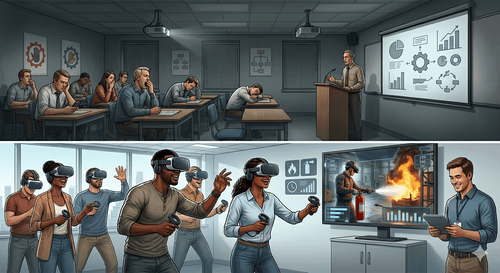
Your workers are passing the assessments. Your incidents are not going down. These two facts are trying to tell you something.
Every industrial organisation has a safety training programme. Most have invested significantly in developing it. The content is usually comprehensive, the SOPs are well-documented, the instructors are competent, and the compliance records are meticulously maintained. The training department can demonstrate that every worker has completed the required modules, passed the assessments, and received the necessary certifications.
And yet. The near-miss reports keep coming. The incident rate is stubbornly flat. The same types of errors keep recurring. New hires take months to internalise what should be basic safety behaviours. And the EHS team has a nagging suspicion that the training programme is checking boxes rather than changing behaviour.
If any of this sounds familiar, your safety training is probably not working as well as your compliance records suggest. Here are five indicators that confirm it, and what you can do about each one.
Key takeaways
- High assessment scores with a flat incident rate signal training that is not changing behaviour.
- Recurring incident types, site-to-site inconsistency, and rapid forgetting are warning signs.
- Slow ramp-up for new hires points to training that does not build real competence.
- Immersive simulation addresses these by making training consistent, measurable, and practice-based.
Sign one: your assessment scores are high but your incident rate is flat
This is the most common and most misleading indicator. Workers consistently score eighty or ninety percent on post-training assessments. The training department reports high pass rates. And yet, when you look at the actual incident and near-miss data over the past two or three years, the numbers have not improved.
The disconnect is usually between the type of assessment and the type of performance the training is supposed to produce. Most safety training assessments are written tests, multiple choice questions, true-or-false statements, short answers. These test recall. Can the worker remember the correct answer when prompted? That is a different skill from executing the correct response when an alarm sounds, when visibility is poor, and when other workers are moving around them.
A worker can score perfectly on a written test about confined space entry procedures and still freeze when they actually need to enter a confined space. The test measured whether they knew the steps. It did not measure whether they could perform the steps under realistic conditions.
The fix is to shift from knowledge-based to performance-based assessment. This means testing workers in conditions that approximate the actual environment where they need to perform. Simulation-based training does this inherently, the assessment is embedded in the experience. Did the worker check atmospheric readings before entering the confined space? Did they maintain communication with the standby person? Did they follow the correct exit procedure when the alarm sounded? These are observable behaviours, not recalled facts. The data tells you what the worker would actually do, not what they know they should do.
Sign two: the same types of incidents keep recurring
Look at your incident and near-miss data from the past three years. If you are seeing the same categories of events repeating, the same types of slips, trips, and falls; the same lockout-tagout errors; the same PPE compliance gaps, your training is not addressing the root cause of those specific behaviours.
Recurring incident patterns typically indicate one of two problems. Either the training does not adequately cover the specific scenario (the worker was never trained on the exact situation they encountered), or the training covers the scenario but does not produce the behavioural change needed to prevent it (the worker knew the procedure but did not follow it under operational pressure).
The first problem is a content gap. The second is a methodology gap. And the distinction matters because the solutions are different.
If workers are encountering situations they were never trained on, the training needs to expand its scenario coverage. This is where simulation-based training has a structural advantage: new scenarios can be added to a VR training library based on actual incident data, and every worker can train on the specific situation within weeks of it being identified. Traditional classroom training cannot respond at this speed because it depends on instructor availability, scheduling, and curriculum redesign.
If workers know the procedure but do not follow it under pressure, the training methodology needs to change. Passive learning, reading, watching, listening, does not build the automatic responses that high-pressure situations demand. Active practice in realistic conditions does. This is the fundamental argument for simulation-based safety training: it produces muscle memory, not just factual knowledge.
Sign three: training quality varies dramatically between sites
If you operate multiple facilities, whether it is three plants or thirty, compare the training outcomes across sites. Look at assessment scores, incident rates, time-to-competency for new hires, and supervisor evaluations of worker readiness. If there is significant variation between sites, your training quality is inconsistent.
In traditional training delivery, this variation is almost inevitable. The instructor at one site may have twenty years of field experience and a gift for engaging a room. The instructor at another site may be a junior HSE officer who reads from a script. The training facility at one plant may have working equipment for hands-on practice. At another plant, the training room might be a repurposed conference room with a projector that overheats.
These variations are not failures of individual instructors or plant managers. They are structural features of a training model that depends on local delivery by local people with local resources. The only way to eliminate them is to standardise the delivery mechanism itself.
Digital training delivery, particularly VR simulation, achieves this standardisation by removing the variables. Every worker, at every site, trains on the same simulation, with the same scenarios, the same assessment criteria, and the same level of fidelity. The simulation does not have good days and bad days. It does not simplify the content because the room is hot and the workers are restless. It delivers the same experience to the thousandth worker that it delivered to the first.
This does not mean eliminating instructors entirely. It means freeing them from repetitive content delivery so they can focus on where human expertise adds the most value: coaching, mentoring, answering questions, and providing context that a simulation cannot.
Sign four: workers forget the training within weeks
If you assess workers on safety procedures three months after training and the scores are significantly lower than the post-training assessment, your training is not producing durable learning. This is not a worker motivation problem. It is a training design problem.
The research on learning retention is unambiguous. People retain roughly ten percent of what they read, twenty percent of what they hear, and seventy-five percent or more of what they learn through practice and experience. Classroom-based safety training, lectures, videos, printed materials, operates almost entirely in the ten to twenty percent retention zone. Workers absorb the information long enough to pass the assessment, then it decays.
Experiential training reverses this. When a worker physically practises an emergency evacuation in a simulated environment, hearing the alarm, making decisions about exit routes, experiencing the time pressure, the memory is encoded differently. It is stored as a procedural memory (how to do something) rather than a declarative memory (a fact about something). Procedural memories are far more durable and far more accessible under stress.
The practical implication is that if your training is not producing durable retention, you need to change the modality, not the content. The information in your training materials may be perfectly accurate. The problem is that reading it and hearing it are not effective methods for embedding it in long-term memory. Practice is.
Additionally, refresher training should not simply repeat the initial programme. It should be shorter, more targeted, and focused on the specific scenarios where retention has declined. VR simulation is particularly effective for refresher training because workers can complete a focused scenario in fifteen to twenty minutes, short enough to fit into a shift without major disruption, but immersive enough to reactivate the procedural memory.
Sign five: new hires take too long to become safe and productive
Track the time between a new worker's first day and the point at which their supervisor considers them fully competent to work independently. If this period is longer than it should be, and in most industrial operations, it is, the training programme is not accelerating competency development effectively.
In traditional onboarding, a new hire goes through classroom induction, watches orientation videos, receives their PPE, takes the written assessment, and then goes to the floor under supervision. They learn the actual job through observation, shadowing, and gradual assumption of responsibility. This process works, but it is slow and it places a significant burden on supervisors and experienced workers who are pulled from their own duties to mentor new hires.
The fundamental limitation is that the classroom portion of onboarding provides knowledge, but the competency building happens on the job. The worker has to learn the physical layout of the facility, the location and operation of safety equipment, the specific hazards in their work area, and the correct responses to emergency scenarios, all while simultaneously learning their actual job tasks.
Immersive training compresses this process by allowing new hires to build spatial awareness and procedural familiarity before they step onto the operational floor. A new hire at a cement plant can walk through the virtual facility on their first day, locate every fire extinguisher, every emergency exit, every isolation point. They can practise the emergency procedures they need to know before they encounter the actual equipment. By the time they reach the floor for supervised practice, they already know the layout, the hazards, and the responses. The supervisor's role shifts from basic orientation to refinement and coaching.
Organisations that have implemented VR-based onboarding consistently report that new hires reach independent competency significantly faster than those trained through traditional methods alone. The time savings apply both to the new hire and to the experienced workers who no longer need to provide as much hands-on orientation.
The five warning signs at a glance
- Assessment scores are high, but the incident rate stays flat.
- The same types of incidents keep recurring.
- Training quality varies dramatically between sites.
- Workers forget the training within weeks.
- New hires take too long to become safe and productive.
What these signs are really telling you
If you recognise one or more of these patterns in your operation, the underlying message is the same. Your training content is probably sound. Your compliance processes are probably adequate. What is not working is the delivery method.
Passive, classroom-based delivery was the best option available for decades. It was better than no training, better than learning purely through trial and error on live equipment. But the research, the technology, and the operational evidence now point clearly to a better approach: experiential, simulation-based training that builds behavioural competency through practice rather than factual knowledge through instruction.
This does not mean abandoning classroom training entirely. There are aspects of safety education, regulatory knowledge, theoretical understanding of hazard mechanisms, incident case studies, that are well served by classroom or e-learning delivery. But for the performance-critical skills, emergency response, hazard recognition, procedure execution under pressure, simulation-based training produces measurably better outcomes.
The question is not whether your safety training programme can be improved. It almost certainly can. The question is whether the improvement you pursue is another iteration of the same methodology that produced the current results, or a fundamentally different approach that addresses the underlying limitations of passive learning.
Related reading and resources
- VR Training Solutions
- Industrial LMS
- Safety Training
- How to Measure Immersive Training Effectiveness
- The ROI of VR Training
- How Oil and Gas Companies Use VR for Emergencies
EDIIIE helps industrial organisations diagnose training effectiveness gaps and deploy simulation-based solutions that produce measurable improvements in safety outcomes. With 170+ projects across manufacturing, oil and gas, power and energy, infrastructure, and defence, we understand the operational context that determines whether training actually works. Talk to us about your training challenge.