How Oil and Gas Companies Use VR to Train for Emergencies They Cannot Rehearse in Real Life

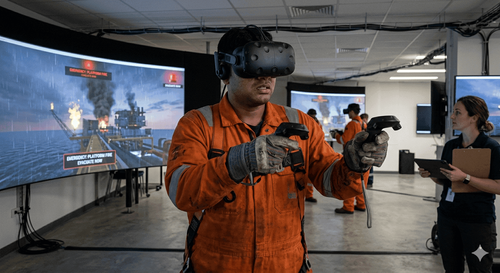
You cannot set a real fire on an offshore platform to see if your crew knows what to do. VR lets you do exactly that.
The oil and gas industry has a training problem that is fundamentally different from most other sectors. The scenarios that workers most urgently need to be prepared for, blowouts, gas leaks, well control emergencies, fires on offshore platforms, are precisely the ones that cannot be practised in real life. You cannot release hydrogen sulphide into a live refinery to test whether workers can identify the alarm, don their breathing apparatus, and evacuate in the correct sequence. You cannot simulate a well kick on an active drilling rig to see if the driller responds with the right choke pressure adjustments.
For decades, the industry managed this gap with classroom training, tabletop exercises, and occasional live drills with limited scope. Workers studied emergency procedures in binders. They watched videos of past incidents. They participated in muster drills that tested assembly, not decision-making. Then they went back to the rig or the refinery and hoped they would never need to use what they had learned. And when they did, the gap between knowing a procedure intellectually and executing it under pressure became a matter of life and death.
This is why the oil and gas sector has become one of the most aggressive adopters of VR-based safety training globally. The use case is not aspirational. It is existential.
Key takeaways
- VR lets oil and gas teams rehearse emergencies that are too dangerous to practise for real.
- Scenarios include blowout prevention, H2S exposure, confined space entry, and evacuation.
- Classroom training cannot build the decision reflexes these high-pressure events demand.
- Deployments report safety gains plus operational benefits like faster competency and fewer disruptions.
The scenarios that keep HSE managers awake
To understand why VR training is gaining traction so rapidly in oil and gas, you need to understand the specific scenarios it addresses. These are not generic safety topics. They are the highest-consequence, lowest-frequency events that the industry faces.
Well control and blowout prevention is arguably the most critical. A well kick, an unexpected influx of formation fluid into the wellbore, can escalate to a blowout within minutes if the driller does not respond correctly. The correct response involves recognising the kick indicators (pit gain, flow rate increase, drill pipe pressure change), shutting in the well using the correct procedure, and managing the kill operation. Every step is time-critical. Every error compounds. In the real world, a driller might go years without encountering a kick. In VR, they can practise the response weekly until it becomes automatic.
Hydrogen sulphide response is another scenario where VR training is proving transformative. H2S is colourless and lethal at concentrations above a few hundred parts per million. Workers in sour gas environments need to recognise the alarm, hold their breath, reach their escape breathing apparatus, don it correctly, and move to the designated safe point, all within seconds. The procedure is simple on paper. Under the panic of a real alarm, with limited visibility and physical disorientation, it is a different matter entirely. VR simulates the full sensory experience: the alarm, the restricted visibility, the time pressure, the need to navigate to safety while other workers are also moving.
Confined space entry and rescue is a scenario that causes a disproportionate number of fatalities relative to its frequency. The procedure involves atmospheric testing, continuous monitoring, buddy systems, and rescue protocols that most workers rarely practise outside of annual certification. VR allows workers to experience the claustrophobia, the limited movement, the equipment constraints, and the decision-making complexity of a confined space operation, including the critical judgment call of when to enter a space to rescue a colleague and when to wait for the rescue team.
Fire and explosion response on offshore platforms adds a layer of complexity that land-based facilities do not face. There is nowhere to run. Evacuation means lifeboats, not car parks. The assembly procedures, firefighting responses, and abandon-platform protocols need to work under conditions of extreme stress, limited visibility, and a crew that may include injured personnel. VR simulates these conditions with sufficient fidelity that workers develop the spatial awareness and procedural memory they need before they ever face a real emergency.
Why classroom training falls short for these scenarios
The limitation of classroom training is not that it teaches the wrong information. The procedures taught in classroom sessions are usually accurate and comprehensive. The limitation is that it teaches them in the wrong modality.
Emergency response is not a knowledge problem. It is a performance problem. The gap is not between knowing the H2S evacuation procedure and not knowing it. The gap is between knowing the procedure and being able to execute it when the alarm sounds, the air smells wrong, and the person next to you is panicking. That gap is not bridged by reading. It is bridged by practice.
The psychological literature on performance under stress is clear on this point. People revert to their level of training, not their level of knowledge. If a worker has read the confined space rescue procedure ten times but has never physically executed it, they will hesitate. If they have practised it in a realistic simulation fifty times, they will act. The response will be automatic because the neural pathways have been built through repetition in a high-fidelity environment.
This is not a theoretical distinction. It is the difference between a crew that executes a well shut-in procedure in four minutes and a crew that takes eleven minutes because they are checking the manual. In a well control situation, those seven minutes can determine whether the kick is controlled or whether it escalates to a blowout.
What a VR training deployment looks like in oil and gas
The implementation of VR training in oil and gas differs from most other industries in several important ways.
First, the environments are built to match specific facilities. A VR simulation of a generic refinery has limited training value. What matters is that the worker practises on a virtual replica of their actual platform, their actual processing unit, their actual control room. The equipment is in the right place. The valves they need to close are where they actually are. The escape routes match the facility they work in. This level of specificity requires detailed site surveys, equipment modelling, and process validation, but it is what makes the training transferable to real-world performance.
Second, the scenarios are built with process engineers and HSE teams, not just instructional designers. The physics of a well kick, the dispersion pattern of an H2S release, the thermal dynamics of a hydrocarbon fire, these need to be modelled accurately enough that the trainee's experience is representative of what they would face in reality. This does not mean the simulation needs to be a perfect physics engine. It means the key decision-relevant cues need to be present and realistic.
Third, assessment is built into the experience. The VR system tracks every action the trainee takes. Did they check the wind direction before approaching the H2S zone? Did they verify atmospheric readings before entering the confined space? Did they use the correct shut-in procedure for the type of kick they encountered? This data feeds into competency records that are far more meaningful than a written test score. You can see not just whether a worker knows the procedure, but whether they can execute it under realistic conditions.
Fourth, deployment often needs to reach remote and offshore locations. This has historically been a barrier for technology-based training, but current-generation standalone VR headsets have eliminated the need for powerful PCs, dedicated rooms, or reliable internet connectivity during the training session. Content can be pre-loaded and the headset can operate anywhere, on an offshore platform, at a remote drilling camp, or in a mobile training unit at a pipeline construction site.
The operational gains beyond safety
While safety training drives most initial VR deployments in oil and gas, the operational benefits extend further.
Equipment familiarisation for new hires is a significant application. A worker rotating onto a new platform can spend time in the VR replica before arriving, learning the layout, locating key equipment, and understanding the process flow. This reduces the on-site orientation period and means the worker is productive faster. For offshore operations where bed space is limited and every day of unproductive labour represents significant cost, this acceleration has direct financial value.
Permit-to-work procedure training is another area where VR adds value. The permit-to-work system is central to safe operations in oil and gas, but the paperwork-driven nature of the process means that workers often learn it as an administrative exercise rather than as an operational practice. VR can simulate the full permit cycle, from isolation and tagging through to task execution and system restoration, in the context of a realistic operational scenario, reinforcing the connection between the paperwork and the physical actions it governs.
Startup and shutdown procedures for process units are complex, time-sensitive operations where errors can have severe consequences. VR allows operations teams to rehearse these procedures on virtual replicas of their specific process units, identifying potential issues with the procedure sequence before executing it on live equipment. This is particularly valuable for commissioning new facilities or for restart operations after extended turnarounds.
What the deployment data shows
Oil and gas companies that have deployed VR training at scale report results that are consistent with broader industry data but amplified by the sector's specific characteristics.
Training throughput increases because the VR simulation can be run continuously, it does not require an instructor for every session, a dedicated training rig, or coordination with live operations. Workers can train during crew change periods, during weather standby on offshore platforms, or during any scheduled downtime. This addresses one of the persistent challenges in oil and gas: finding training time for workers who are on rotation schedules and whose time on-site is expensive.
Competency consistency improves across distributed operations. An upstream operator with platforms across multiple basins no longer depends on the quality of the local trainer or the availability of the training rig at each location. Every worker, on every platform, trains on the same simulation with the same assessment criteria.
Incident investigation and learning integration becomes faster. When an incident or near-miss occurs, the relevant scenario can be rapidly built or updated in VR, and the entire workforce can train on the specific situation within weeks. This turns incident learning from a retrospective document that workers read and forget into an experiential exercise that builds the specific competencies the incident revealed were lacking.
The direction ahead
The trajectory in oil and gas is clear. VR-based training is moving from pilot projects and innovation demonstrations to standard operating practice. The companies adopting it now are not early adopters in the technology sense. They are risk managers who have concluded that the traditional approach to high-consequence, low-frequency training does not adequately prepare their workforce for the scenarios that matter most.
The technology is mature. The deployment models are proven. The evidence base is substantial. And the alternative, continuing to prepare workers for life-threatening emergencies using PowerPoint slides and tabletop exercises, is becoming increasingly difficult to justify to boards, regulators, and the workers themselves.
Related reading and resources
- VR Training Solutions
- Oil & Gas
- Safety Training
- 5 Signs Your Safety Training Is Not Working
- The ROI of VR Training
- How to Measure Immersive Training Effectiveness
EDIIIE builds VR training simulations for oil and gas operations, from upstream drilling to downstream processing. With deep domain expertise across well control, process safety, confined space operations, and emergency response, we design simulations that are validated by your process engineers and deployed across your entire operation. Talk to us about your training challenge.