VR safety training with scored competency assessment and a dated digital certificate, deployable on standalone headsets across every site, in Hindi and English.
Chemical safety training must teach workers to recognise the GHS hazard pictograms and signal words on a label, find and read the relevant Safety Data Sheet (SDS), store incompatible chemicals apart, and contain and respond to a spill or release using the correct PPE and equipment. Under OSHA’s Hazard Communication Standard (29 CFR 1910.1200) and the GHS, every worker who may be exposed to a hazardous chemical must be trained on these before exposure. EDIIIE’s Chemical Safety module trains all of it in VR: the trainee reads GHS labels in a realistic store, navigates an SDS to find the right response, identifies an unsafe storage arrangement, and contains a simulated spill, including the decision of when to evacuate rather than tackle it. Toxic, flammable and corrosive scenarios can be run at full realism with zero exposure. Every attempt is scored and certified.
This module is designed around GHS / SDS (OSHA HazCom 1910.1200) and delivered as an immersive VR simulation with three progressive modes, Learn, Practice and Assessment, with progression gated on competency. Every trainee finishes with a scored result and a dated digital certificate recorded in the LMS.
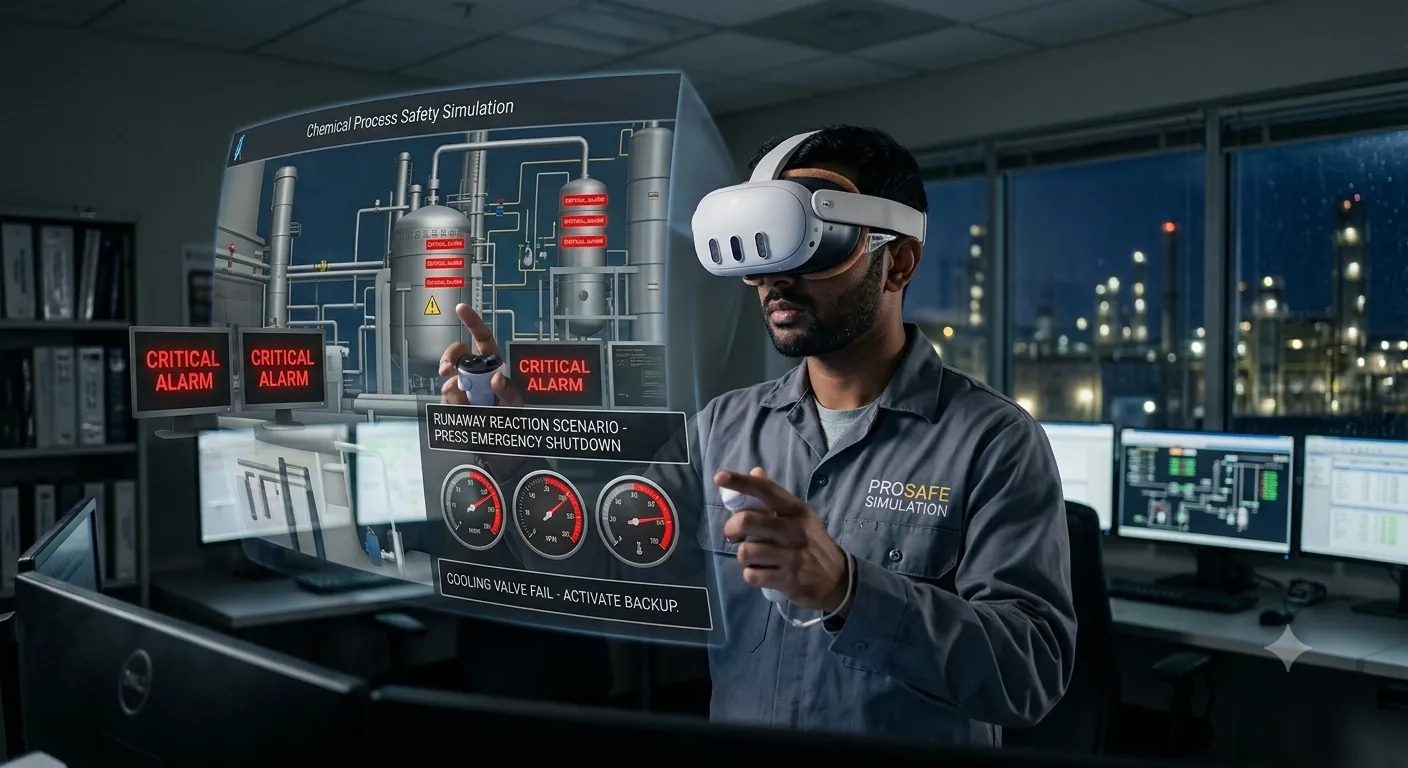
Screens from the Chemical Safety module. Every scenario is rebuilt from real plant conditions so the hazard, the equipment and the procedure match what the worker meets on shift.


A chemical spill drill on a real site is expensive, disruptive and, if it involves anything genuinely hazardous, dangerous, so most sites never rehearse one until a real release happens. VR removes every one of those barriers. The trainee can face a corrosive spill spreading toward a drain, decide whether to contain or evacuate, select the right PPE and absorbent, and see the outcome of a wrong decision safely. The module records the decisions so a plant can see whether its workforce’s weakness is SDS navigation, PPE selection or the containment sequence, and target refreshers accordingly.
Chemical hazards seldom stand alone, they appear inside confined spaces, alongside fire risk, and always require the correct respiratory and skin protection. EDIIIE builds Chemical Safety to link with the Confined Space, Fire Safety and PPE modules so that a worker on a hazardous task is certified across the whole chain. For oil & gas, power and process-manufacturing sites, this integrated hazardous-materials competency is what an audit actually looks for.
Naming the standard is what separates a vendor page from a blog post, for a buyer and for an answer engine alike. Each element of the module is mapped to the requirement it satisfies.
| Standard | What it requires |
|---|---|
| GHS | Globally Harmonized System, standardised hazard pictograms, signal words and hazard statements. |
| OSHA 29 CFR 1910.1200 | Hazard Communication Standard, SDS availability, labelling and worker training. |
| Factories Act / MSIHC Rules | Indian statutory control of hazardous chemicals and storage. |
One module, three gated modes, the trainee cannot reach assessment until they have demonstrated the procedure in practice.
A guided walkthrough of the procedure and the standard behind it, at the trainee's own pace, with the hazard shown safely at full realism.
The trainee performs the procedure themselves in an interactive scenario, repeating until the sequence is correct. Wrong choices show their consequence safely.
A scored assessment against the standard. On a pass, the LMS issues a dated digital certificate and logs completion, competency score and error-per-step for audit.
At Hindalco’s aluminium smelters, EDIIIE’s VR anode-change programme (“Pot Processing, The Hindalco Way”) trained operators for a process that runs beside molten aluminium above 900°C, toxic fluoride fumes and high electrical current. Operators reached competency 40% faster, near-misses in live operation fell 60%, and assessed compliance scores rose 35%, all measured against the pre-VR classroom baseline.

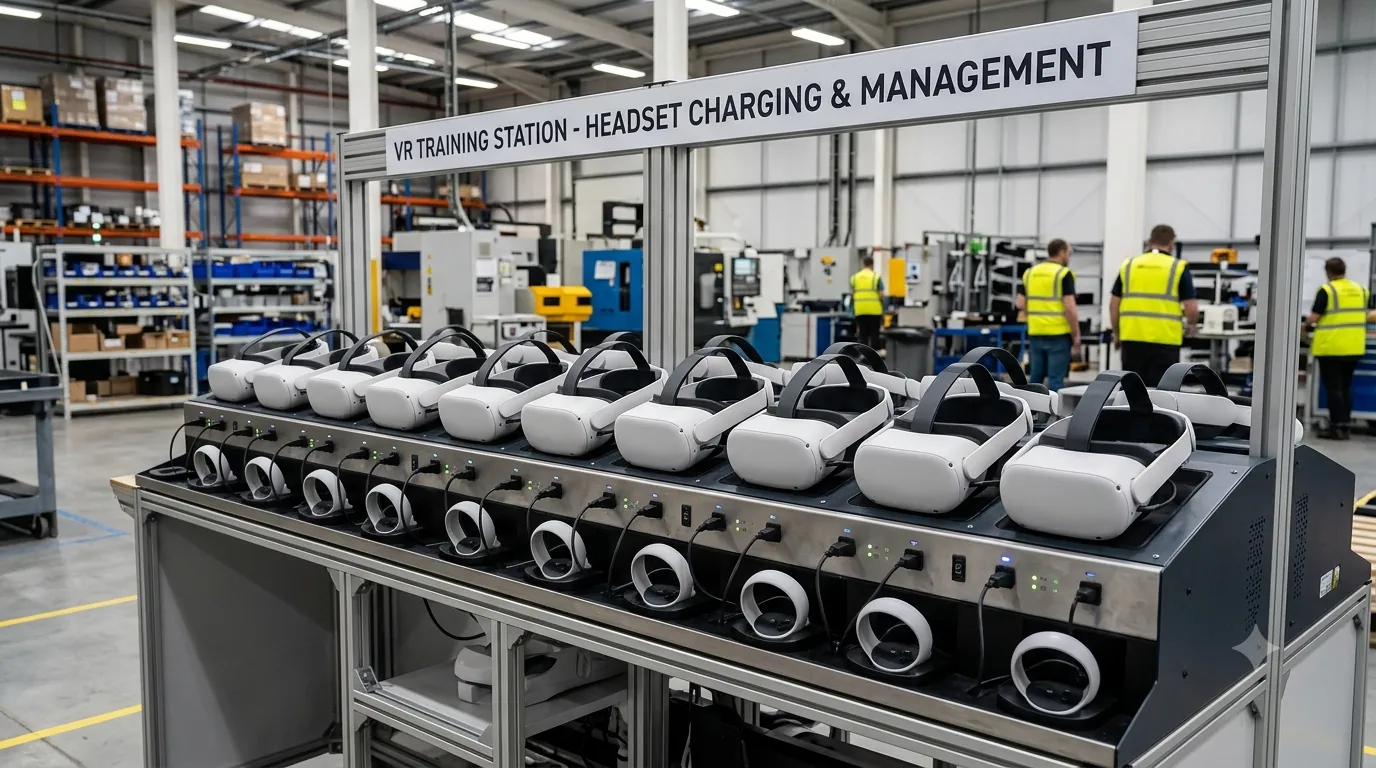
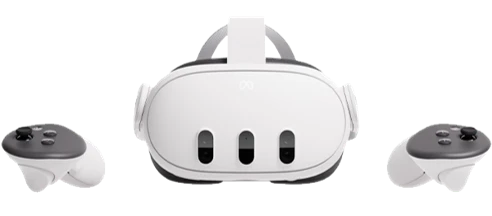
The same module ships to every site on a fleet of Meta Quest headsets with a charging station and a companion tablet for the instructor.

A rack of headsets lives at the plant. Trainees pick one up, complete the module and hand it back; scores sync to the LMS when the headset reaches Wi-Fi. No dedicated PC per seat and no simulator room to build.

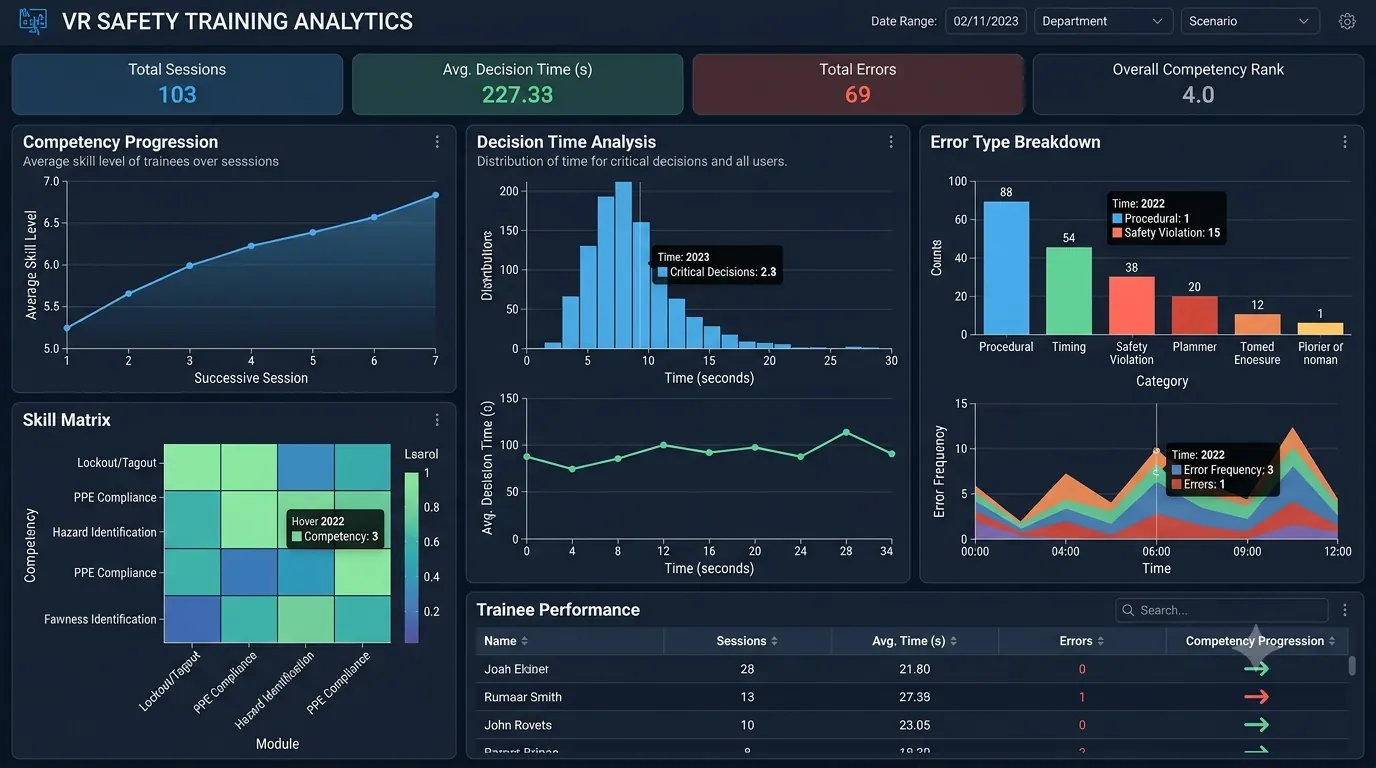
Assessment mode records decision time, procedural errors and safety violations per step. The safety officer sees competency progression per trainee and per department, and the LMS issues a dated digital certificate on a pass.

Every module is built and tested for standalone Quest hardware. Headsets and the charging station can be supplied with the programme, or the module is deployed onto a fleet you already own.
This module is deployed across EDIIIE's industry programmes. Explore how it fits each sector:
Book a demo and see the Chemical Safety module running on a headset, scored against GHS / SDS (OSHA HazCom 1910.1200).
Request this module